

A carbon footprint is a very broad idea. It covers emissions from boilers, company cars and the energy a firm buys. It also covers emissions from making raw materials at suppliers and from using the products that a firm sells. Without shared rules, every firm would count something different, and nobody could compare the results. The GHG Protocol is a group of standards that gave this work a clear method. It sets which emissions a firm includes and how it splits them into scopes. Today, these standards are the basis for carbon footprints in business. In 2023, 97% of S&P 500 firms that disclosed data to CDP reported their emissions with the GHG Protocol.
- GHG Protocol: free standards for measuring and reporting greenhouse gas emissions, published since 2001 by WRI and WBCSD.
- Scopes 1, 2 and 3: own emissions, emissions from purchased energy and value chain emissions; the corporate standard requires the first two.
- ISO 14064-1: a standard with the same principles that splits emissions into six categories instead of three scopes.
- Who must use it: the GHG Protocol itself is voluntary; ESRS E1 and the SBTi, among others, require it.
- New version: the GHG Protocol and ISO will publish a joint standard; consultation in Q2 2027, publication in Q4 2028.
What is the GHG Protocol and who develops it?
 The GHG Protocol, or Greenhouse Gas Protocol, is a set of standards. They explain how to measure and report greenhouse gas emissions. Two organisations develop it together. The World Resources Institute (WRI) is a research organisation based in Washington. The World Business Council for Sustainable Development (WBCSD) is a group of large international firms. Work started in 1998 with BP, General Motors, Shell, WWF and others. The first edition of the corporate standard came out in 2001. The version in use today dates from 2004.
The name can confuse people. The GHG Protocol is not an international treaty like the Kyoto Protocol, and it is not a law. It is a set of voluntary standards that anyone can download free of charge from ghgprotocol.org. The European Sustainability Reporting Standards (ESRS), IFRS S2, the Science Based Targets initiative (SBTi) and the CDP questionnaire all build on it. So you can compare your result with the results of other firms.
Technical working groups write the drafts. Each draft goes out for public comment. Then the Independent Standards Board approves it. The GHG Protocol does not certify firms or approve their reports. An outside expert body checks if the figures follow the standard. This check is called verification, and it usually follows ISO 14064-3.
Which standards does the GHG Protocol include?
 Several documents carry the GHG Protocol name. Three of them matter most for a firm: the Corporate Standard, the Scope 2 Guidance and the Scope 3 Standard. Together, they explain how to calculate a corporate carbon footprint. The other documents cover products, emission reduction projects, and land use and CO₂ removals.
| Name | What it covers | Published |
|---|---|---|
| Corporate Standard | principles, boundaries, Scopes 1 and 2, base year, report | 2001; current version 2004, amended 2013 |
| Scope 2 Guidance | location-based and market-based methods | 2015 |
| Scope 3 Standard | 15 categories of value chain emissions | 2011 |
| Scope 3 Calculation Guidance | how to calculate each category | 2013 |
| Product Standard | product carbon footprint over the whole life cycle | 2011 |
| Project Protocol | emission reductions from projects, for example a wind farm | 2005 |
| Land Sector and Removals Standard | emissions from land use and CO₂ removals | 2026; applies from 1 January 2027 |
Other GHG Protocol standards are for cities and governments. They help them set reduction goals and assess climate policies. For a product carbon footprint, you can use the Product Standard or ISO 14067. We explain the difference in our article on corporate and product carbon footprints.
What principles does the GHG Protocol set?
 The principles help you with cases that the standard does not cover in detail. For example, can you leave out a small emission source? What do you do when a supplier sends no data? The Corporate Standard bases every GHG inventory on five principles:
- Relevance: the inventory boundary reflects how the firm works, and the result supports decisions of the firm and of report users.
- Completeness: the report covers all emission sources within the chosen boundary, and it discloses and explains each exclusion.
- Consistency: methods and boundaries stay the same from year to year, and each change is described, so you can compare years.
- Transparency: assumptions, data sources and emission factors are described, so another person could repeat the work.
- Accuracy: the result is not too high or too low, and uncertainty is as small as possible.
ISO 14064-1 uses the same principles. Relevance and completeness also decide which Scope 3 categories you must calculate. They also decide which ones you may leave out with a reason.
How does the GHG Protocol divide emissions? Scopes 1, 2 and 3
 The three scopes are the best-known part of the GHG Protocol. Scopes 1 and 2 do not overlap, so no emission counts twice in the inventory of one firm. The standard splits emissions by where they come from:
- Scope 1: direct emissions from sources that the firm owns or controls. Examples are gas burnt in a boiler, fuel in company cars, industrial processes and refrigerant leaks.
- Scope 2: indirect emissions from producing the electricity, heat, steam and cooling that the firm buys and uses.
- Scope 3: all other indirect emissions in the value chain, from purchased raw materials to the end of life of sold products. The standard splits them into 15 categories.
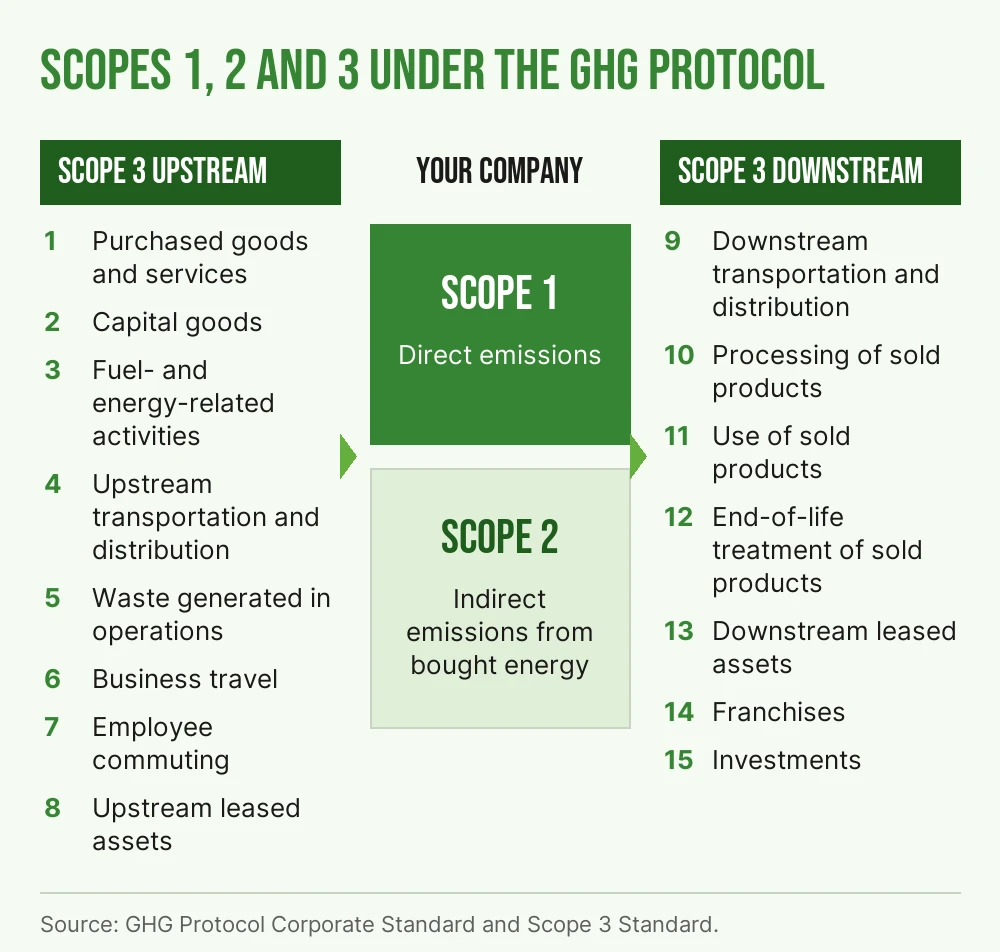
The Corporate Standard requires Scopes 1 and 2. It leaves Scope 3 to the firm. Yet at CDP reporters, supply chain emissions are on average 26 times higher than Scope 1 and 2 emissions (CDP and BCG, 2024). If you report Scope 3, you use the separate Scope 3 Standard. You include all relevant categories and explain any that you leave out. In practice, laws, programmes and customers decide if you calculate Scope 3. We describe all 15 categories in our article on Scope 3 emissions.
Since 2015, you calculate Scope 2 with two methods. The location-based method uses the average emission factor of the grid in your country. The market-based method uses factors from your energy contracts, including guarantees of origin. The report shows both results. We explain the difference in our article on location-based and market-based methods.
How do you set organisational boundaries?
 Before you calculate emissions, you decide which firms and sites are part of your business. These are the organisational boundaries. The answer is not always clear in a group of firms, in a joint venture or with leased equipment. The Corporate Standard gives three approaches:
- Equity share: you include the emissions of each firm in proportion to your share. For example, you include 30% of the emissions of a firm in which you hold 30%.
- Financial control: you include 100% of the emissions of entities under your financial control. These are usually the entities in your consolidated financial statements.
- Operational control: you include 100% of the emissions of entities where you can introduce and apply your own operating policies, even without a majority share.
You choose one approach and use it in the whole group, in the same way every year. The revised ESRS E1 uses financial control as the starting point. This boundary is close to the boundary of the financial statements. The next step is operational boundaries: the list of emission sources within these boundaries, assigned to Scopes 1, 2 and 3.
Which greenhouse gases does the GHG Protocol cover?
 A GHG Protocol inventory covers seven greenhouse gases. Six of them come from the Kyoto Protocol. The seventh, nitrogen trifluoride, was added in 2013. In a firm, these gases usually come from the following sources:
| Gas | Typical source in a firm |
|---|---|
| carbon dioxide (CO₂) | burning fuel in boilers, furnaces and vehicles |
| methane (CH₄) | burning fuel, waste, natural gas leaks |
| nitrous oxide (N₂O) | nitrogen fertilisers, burning fuel |
| hydrofluorocarbons (HFCs) | cooling gases in air conditioners and fridges |
| perfluorocarbons (PFCs) | making aluminium and computer chips |
| sulphur hexafluoride (SF₆) | electrical switchgear |
| nitrogen trifluoride (NF₃) | making computer chips and solar panels |
You convert each gas into carbon dioxide equivalent (CO₂e) with its global warming potential (GWP). The GWP compares the effect of a gas on the climate with the effect of the same mass of CO₂. The GHG Protocol recommends the values from the latest, sixth IPCC report. The report shows emissions in tonnes of CO₂e by scope, and also each gas separately. You report CO₂ from burning biomass, such as wood, separately, outside the scopes.
How does the GHG Protocol differ from ISO 14064-1?
 ISO 14064-1 is an international standard on measuring and reporting the greenhouse gas emissions and removals of an organisation. The current version dates from 2018. In Europe, it is published as EN ISO 14064-1:2019. In 2007, ISO, WRI and WBCSD agreed that the two documents are consistent and can be used together. They still differ in a few points:
| Feature | GHG Protocol | ISO 14064-1 |
|---|---|---|
| Who publishes it | WRI and WBCSD | ISO and national standards bodies |
| Access | free | paid standard |
| Emission split | Scopes 1, 2 and 3 | six categories: direct, bought energy, transport, bought products, use of sold products, other sources |
| Other indirect emissions | Scope 3 optional in the Corporate Standard | required if significant; the firm decides what is significant |
| Verification | optional; the standard gives only general advice | rules in ISO 14064-3 |
You can move a result from one split to the other. ISO category 1 matches Scope 1, and category 2 matches Scope 2. Categories 3 to 6 cover what the GHG Protocol calls Scope 3. A firm under ESRS calculates emissions with the GHG Protocol. It can order verification under ISO 14064-3. This difference will disappear, because the GHG Protocol and ISO are merging their corporate standards.
Who must use the GHG Protocol?
 The GHG Protocol itself does not oblige anyone. The duty comes from laws and programmes that refer to it, and then from customers:
- ESRS E1: firms with more than 1,000 employees and more than €450 million net turnover report Scopes 1, 2 and 3 under the GHG Protocol. This applies from financial year 2027 (ESRS E1).
- VSME: this voluntary standard for smaller firms covers Scopes 1 and 2, calculated with the GHG Protocol in mind. Scope 3 is optional (VSME standard).
- IFRS S2: this is the climate standard of the International Sustainability Standards Board (ISSB). It requires the GHG Protocol unless local law requires another method. The UK based its own UK SRS on it.
- SBTi: it approves reduction targets only after a GHG inventory. The inventory must follow the Corporate Standard, the Scope 2 Guidance and the Scope 3 Standard (science-based targets).
- CDP: over 22,000 firms disclosed environmental data through CDP in 2025. The questionnaire asks for emissions by scope and for the standard used (CDP reporting).
- UK public procurement: suppliers to the public sector submit a Carbon Reduction Plan (PPN 006) with emissions calculated under the GHG Protocol.
- Customers: a firm that calculates Scope 3 asks its suppliers for their emissions, usually in a questionnaire. From 2027, the VSME limits what firms under ESRS can ask smaller suppliers for.
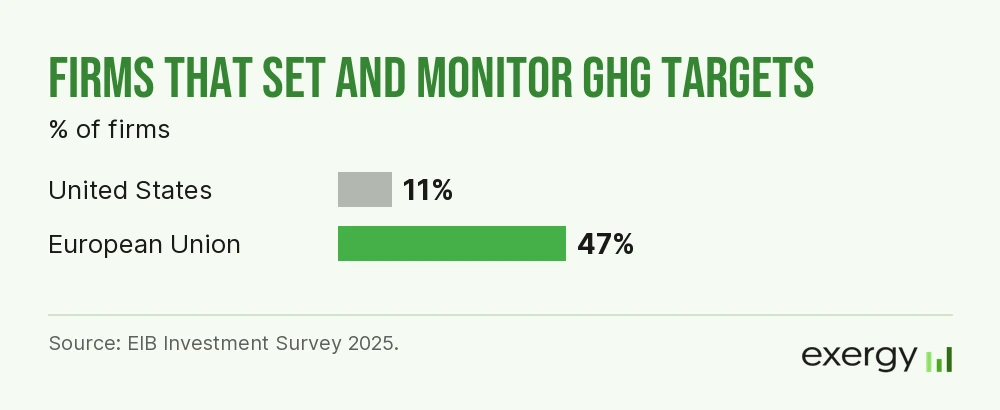
In the EIB Investment Survey 2025, 47% of EU firms said that they set and monitor targets for their own greenhouse gas emissions. In the United States, the share was 11%. The European Investment Bank surveyed over 12,000 EU firms between April and July 2025. Large firms have targets much more often than small ones. A target needs a GHG inventory first, because it sets a reduction from a measured base year.
What will change in the GHG Protocol by 2028?
 The Corporate Standard dates from 2004, the Scope 3 Standard from 2011 and the Scope 2 Guidance from 2015. The GHG Protocol is updating them in four areas: the Corporate Standard, Scope 2, Scope 3, and actions and market instruments. On 9 September 2025, the GHG Protocol and ISO announced a partnership. On 29 July 2026, they presented the work plan:
- One standard instead of four documents: the Corporate Standard, the Scope 2 Guidance, the Scope 3 Standard and ISO 14064-1 will merge. The result will be one joint standard with both logos.
- Two parts: part 1 will cover general requirements and the emissions inventory. Part 2 will cover actions and market instruments, such as renewable energy contracts and carbon credits.
- Dates: the draft goes to public consultation in Q2 2027. The final standard is planned for Q4 2028, and the date from which firms must use it will come later.
- Scope 2: the consultation from October 2025 to January 2026 received almost 1,100 responses from 56 countries. Proposals for hourly matching and for physical delivery of energy had low support.
In July 2026, the Independent Standards Board asked for more work on several versions of the market-based method. Until the joint standard is published, the current documents apply. Reports prepared under them need no corrections. We describe the details in our article on Scope 2 guidance revision and ISO harmonisation.
How to start a carbon footprint under the GHG Protocol?
 Collecting data takes the most time in a first inventory. So start with the decisions that tell you which data you need. A first GHG inventory has six steps:
- Organisational boundaries: choose an approach, such as financial control, and list the firms and sites in the inventory.
- Emission sources: list the sources in Scopes 1 and 2, and do a screening of the Scope 3 categories.
- Base year: pick the first year with complete data, and set rules to recalculate it after an acquisition, a sale or a change of method.
- Data and emission factors: collect fuel and energy use, spend, and weights and distances in transport. Use emission factors from reliable sources, such as the UK Government GHG conversion factors.
- Calculation and report: show emissions in tonnes of CO₂e by scope and by gas. Describe methods, assumptions and exclusions, as in a carbon footprint report.
- Verification: an outside expert body checks your data and figures, usually under ISO 14064-3. It then issues a verification statement.
We show calculations with examples for each scope in our article on how to calculate a carbon footprint.
Need a carbon footprint under the GHG Protocol?
An automotive component maker needed emissions data, and the work had to fit its own resources. We split the project into stages:
- Scopes 1 and 2: calculation under the GHG Protocol and a calculator for the team's own work;
- Scope 3: a data collection method, calculation of relevant categories and a calculator.