
Since the Omnibus I package of 2026, the CSRD asks for a climate report only from the largest companies. From financial year 2027, these are EU companies with more than 1,000 employees and more than EUR 450 million net turnover. Most suppliers are much smaller. But their large customers report Scope 3 emissions, and Scope 3 includes the emissions of suppliers. So the question about your emissions still comes, now from the customer's purchasing team.
- Scope 1, 2 and 3 emissions: the three groups of greenhouse gas emissions that a company reports under the GHG Protocol.
- Scope 1: direct emissions from fuels, vehicles, processes and refrigerants that your company owns or controls.
- Scope 2: indirect emissions from the electricity, heat, steam and cooling that you buy.
- Scope 3: all other indirect emissions in your value chain, in 15 categories.
- Reporting: large companies under the CSRD disclose all three scopes in the ESRS E1 standard.
What is a carbon footprint and why does your company need it?
 A carbon footprint is the total greenhouse gas emissions linked to a company, a product, a service or a process. For a company, it covers direct and indirect emissions. They come from fuels, energy, transport, materials, waste, travel and other activities in the value chain. The carbon footprint measures your company's impact on the climate.
The result is shown in tonnes of carbon dioxide equivalent (t CO₂e). This unit puts all greenhouse gases on one scale. Methane, nitrous oxide and refrigerants warm the climate more than CO₂. So each gas gets a factor that converts it to CO₂e.
The number has practical value for your company. It shows where your emissions come from and how large they are. You can use it to compare ways to cut emissions. You can also use it in your sustainability report. A good calculation also shows where you use too much energy, a poor fuel or an expensive raw material.
How to calculate a carbon footprint with the GHG Protocol?
To calculate your company's carbon footprint, first set your boundaries. Organisational boundaries say which companies, plants or buildings you include. Operational boundaries say which types of emissions you include.
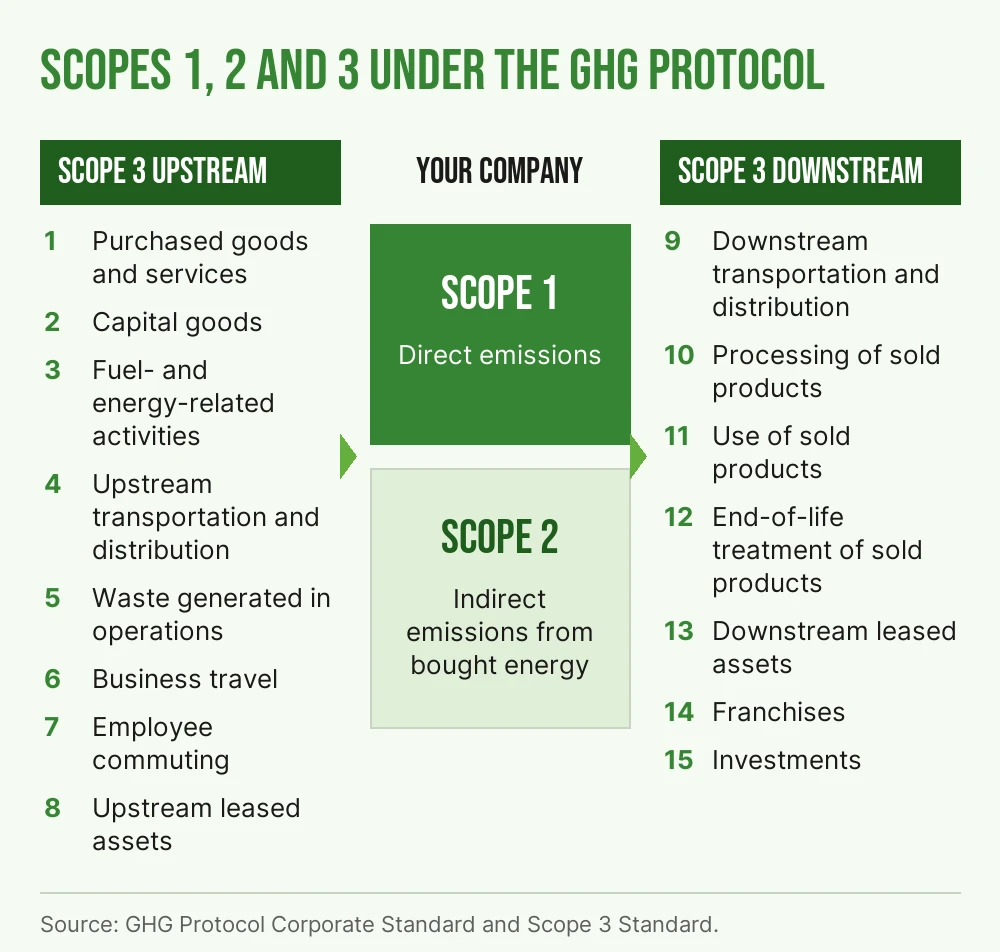
The GHG Protocol Corporate Standard is the most widely used standard for company emissions. It covers seven greenhouse gases. It divides emissions into three scopes: Scope 1, Scope 2 and Scope 3.
- Scope 1 covers direct emissions from sources that your company owns or controls.
- Scope 2 covers indirect emissions from the energy you buy: electricity, heat, steam or cooling.
- Scope 3 covers all other indirect emissions in your value chain.
The GHG Protocol also has separate guidance for Scope 2 and a separate standard for Scope 3. The Scope 3 standard helps you assess emissions in your whole value chain and find areas for reduction (ghgprotocol.org).
The calculation has four steps:
- Collect activity data.
- Choose emission factors.
- Calculate the emissions.
- Prepare a report.
Activity data is what you used or did: gas burned, energy used, litres of fuel, tonnes of materials, kilometres of transport or tonnes of waste. An emission factor turns this data into emissions in CO₂e.
Scope 1: which direct emissions do you include?
 Scope 1 covers emissions from sources that your company owns or controls. For many companies, these are mainly fuels burned in boilers and furnaces: natural gas, heating oil, LPG or coal. Scope 1 also includes fuel for your vehicle fleet, if your company owns the vehicles or controls how they are used.
Scope 1 also includes fugitive emissions. These are leaks of refrigerants from air conditioning, cooling equipment or heat pumps. Companies often miss them. Yet some refrigerants warm the climate thousands of times more than CO₂.
Scope 1 is usually the easiest scope to document. The data comes from invoices, fuel records, meters, fuel cards or technical records. The result is only reliable if you keep fuel types, units and periods apart and check for gaps in the data.
Scope 2: how to include the electricity you buy?
 Scope 2 covers indirect emissions from the electricity, heat, cooling or steam that you buy. Electricity is usually the largest part. Your company does not emit anything where it uses the electricity. The emissions happen in the power plants that produce it.
The GHG Protocol asks for two methods in Scope 2: location-based and market-based. The location-based method uses the average emission factor of the grid in your country or region. The market-based method uses your energy contracts, if they meet the quality criteria. Examples are guarantees of origin and PPAs. A PPA is a long-term contract to buy electricity directly from a producer. The Scope 2 guidance sets common rules for measuring emissions from bought electricity, steam, heat and cooling (ghgprotocol.org).
In countries where much of the electricity still comes from coal or gas, Scope 2 can be a large part of the footprint. Then the result depends on how much electricity you use and how you buy it. You can reduce Scope 2 if you use less energy, put solar panels on your site, sign a PPA or change your energy contract.
Scope 3: why are indirect emissions the hardest?
 Scope 3 covers indirect emissions outside your direct control, but linked to your business. Scope 3 is often the largest and most complex part of the footprint. It includes, for example:
- purchased goods and services,
- transport,
- use and processing of your products,
- waste,
- business travel and employee commuting,
- leased assets.
The GHG Protocol has a separate standard for Scope 3. It describes 15 categories of emissions in the value chain. It helps companies look at their whole value chain, not only their own buildings, machines and cars. The GHG Protocol says that for many companies, most of their total emissions come from Scope 3 (ghgprotocol.org). Read more in our article on Scope 3 emissions.
The hardest part is data quality. Many suppliers do not yet calculate their emissions. A product carbon footprint is often available only for some products. Then you use secondary data: industry averages, or factors based on spend or mass. Report your assumptions, data sources and uncertainty clearly.
What data do you need to calculate a carbon footprint?
 A carbon footprint does not start with a spreadsheet. It starts with a list of your processes and emission sources. For a factory, these are energy, fuels, raw materials, transport, packaging, cooling, waste and logistics. For a service company, offices, energy, travel, digital services and leased assets may matter more.
Next, collect the amounts, for example:
- kWh of electricity and GJ of heat,
- m³ of gas and litres of fuel,
- tonnes of materials and waste,
- kilometres of transport,
- the value of services you bought.
Primary data from your own company is better than averages. A calculator can help you organise the data, but it cannot make the method decisions for you.
Split the data by site, company, business line and period. If you want to compare your footprint year by year, you need to collect the data the same way every year. Without this, it is hard to see if your reduction actions work and how the corporate carbon footprint changes over time.
Is a calculator enough to work out your carbon footprint?
 A calculator is a good tool. It makes the calculation and the report faster. It helps you organise data, do the basic maths and see an approximate footprint. The problem starts when people use a calculator but do not understand boundaries, emission factors, scopes and data quality.
To get a reliable result, you need to know if each item belongs to Scope 1, 2 or 3. You also need to check if the emission factor is current, fits your country and matches the type of activity. You can calculate the same item in different ways. It depends on your data: mass, spend, supplier data or a product carbon footprint.
An expert is not there to type data into a table. The expert sets the method, checks that nothing is missing and makes sure nothing is counted twice. The expert also writes a report that you can show to a customer, an auditor or a bank.
How to report your carbon footprint for ESG and the CSRD?
 Report your carbon footprint in a clear way. Use the same method each year and follow your chosen standard. The report should include:
- organisational boundaries,
- operational boundaries,
- the base year,
- the method you used,
- data sources,
- the emission factors you used,
- results for each scope,
- information on data quality and uncertainty.
Show Scope 1 and 2 apart from Scope 3. You control them more, and the data is better.
The CSRD (Corporate Sustainability Reporting Directive) is the EU law on sustainability reports. Companies under the CSRD report under the European Sustainability Reporting Standards (ESRS). The first companies applied the rules to financial year 2024, in reports published in 2025.
In February 2026, the EU adopted the Omnibus I package, which simplified the reporting rules. Now the legal duty covers only the largest companies (European Commission).
How to use the results to reduce emissions?
 A carbon footprint has the most value when it leads to decisions. The calculation does not reduce emissions by itself. It shows where a cut makes the most sense, in technical and in economic terms. For one company, this means a new heating system. For another, it means saving energy, new logistics, work with suppliers or new product design.
Start with the largest categories that you can control best. If Scope 2 is your main source, start with electricity and energy efficiency. If Scope 3 is the largest, you will need to work with suppliers and look at raw materials, transport and your value chain.
Link your carbon footprint cuts to business goals. A good strategy can help you win customers and tenders and get finance. So the carbon footprint is a management tool, not only an environmental number.
How to calculate a company's carbon footprint step by step?
 Follow a clear process. You do not have to do it yourself: we can calculate your corporate carbon footprint under the GHG Protocol.
First, set the goal. The report may be for a customer, an ESG strategy, an emissions reduction plan or a tender. Then set the boundaries: companies, sites and the reporting period.
Next, find the emission categories. Scope 1 includes, for example, gas, fuel and refrigerants. Scope 2 includes the electricity and heat you buy. Scope 3 can include purchases, transport, waste, business travel and other indirect emissions. Check which Scope 3 categories are relevant to your business.
Then collect the data, choose the emission factors, calculate and prepare the report. Show the total emissions, split by scope, site and main source. With this report, you know your carbon footprint and can plan reduction actions.
When should you work with a carbon footprint expert?
 An external expert is most useful when you will use the result outside your company. For example, in a sustainability report, a tender or a talk with your bank. Here, errors in the method can cost you business. For external reporting, consider an independent verification of your carbon footprint under ISO 14064-3.
Support also helps when your company is complex. For example, it has several plants, many energy sources, a vehicle fleet or a long supply chain. Then you need a consistent calculation under ISO 14064-1 or the GHG Protocol, with clear responsibility for each data set.
A good adviser gives you more than a table of results. The adviser explains what your result means and which emissions matter most. The adviser also helps you prepare data for the next years. And the adviser helps you choose actions that really cut emissions.
Key points to remember
- A carbon footprint is the total greenhouse gas emissions linked to a company, a product or a process.
- The GHG Protocol divides emissions into three scopes: Scope 1, 2 and 3.
- Scope 1 covers direct emissions, Scope 2 the energy you buy, and Scope 3 all other emissions in the value chain.
- To calculate a carbon footprint, you need activity data, the right emission factors and clear boundaries.
- A calculator can help, but it does not replace the method, data checks and expert reading of results.
- Under ESG and the CSRD, report your data clearly, with your assumptions, sources and uncertainty.
- Use your carbon footprint to make decisions: cut emissions, save energy and manage your emissions better.
- Most errors happen in Scope 3, where data is scattered and depends on suppliers.
- Your footprint helps not only in reports, but also with customers, tenders, banks and costs.
- Update your data every year, so you can check your actions and compare results.
Sources
- GHG Protocol: ghgprotocol.org
- Corporate sustainability reporting (CSRD): European Commission