
A customer, a bank or a verifier asks for your carbon footprint report. A single number in tonnes of CO₂e will not satisfy them. They want to see which sites you included, which method you used, where your emission factors come from and what you left out. Without this, they cannot compare your result or trust it.
- Carbon footprint report: a document that shows a company's emissions and how it worked them out, usually under the GHG Protocol.
- Boundaries: which companies and sites the report covers, and how it adds them up.
- Scopes: Scope 1 and 2 always, Scope 3 with the categories included and reasons for those left out.
- Method and results: where the data and factors come from, results by scope and gas, and the base year.
- Cutting emissions: the plan, the actions taken and whether the targets are science-based.
What is a carbon footprint?
 A carbon footprint is the total of greenhouse gases that a company, a product, an event or a project causes, directly and indirectly. It is shown in CO₂ equivalent (CO₂e). This lets you compare gases such as methane and nitrous oxide by how much they warm the climate.
The calculation can cover the whole value chain: from raw materials, through production, transport and use, to the waste from sold products. For a single product, the calculation works differently, as we explain in our guide on how to calculate a product carbon footprint. An accurate company footprint is the basis for reports and for cutting emissions.
What does a carbon footprint report cover?
 A corporate carbon footprint under the GHG Protocol splits emissions into three scopes. This helps a company find and manage each source. Each scope covers a different part of the business.
Scope 1: direct emissions
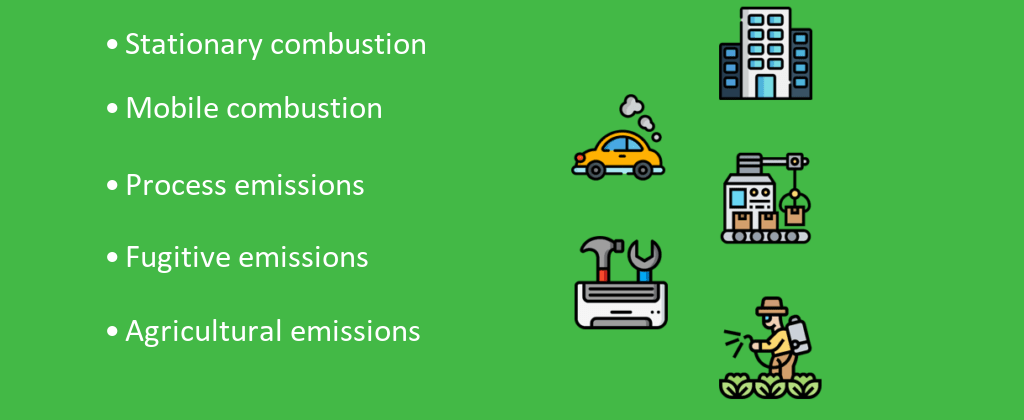
Scope 1 covers direct emissions from sources that the company owns or controls. They include:
| Category | Examples |
|---|---|
| Fuel combustion | Stationary and mobile sources |
| Other | Industrial processes, air conditioning and refrigeration, waste |
You work them out from the fuel used and the right emission factors. To cut them, use less energy, switch to cleaner fuels or add technology that cuts emissions.
Scope 2: indirect emissions from energy
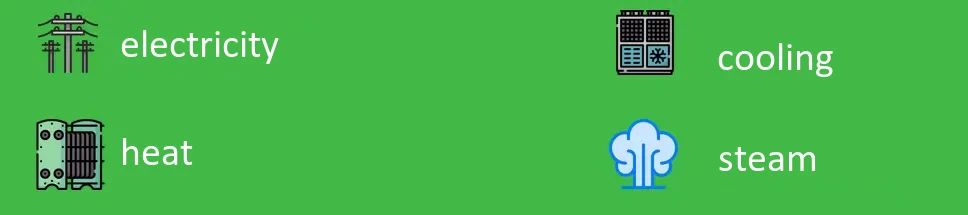
Scope 2 covers emissions from the electricity, heat and steam that a company buys. They arise in the power and heat plants that supply it. You work them out in two separate ways:
| Method | Description |
|---|---|
| Location-based | Uses average emission factors for a region or country |
| Market-based | Uses emission factors specific to your electricity supplier and contracts |
To cut them, use less energy, buy renewable energy or make your own.
Scope 3: indirect emissions in the value chain
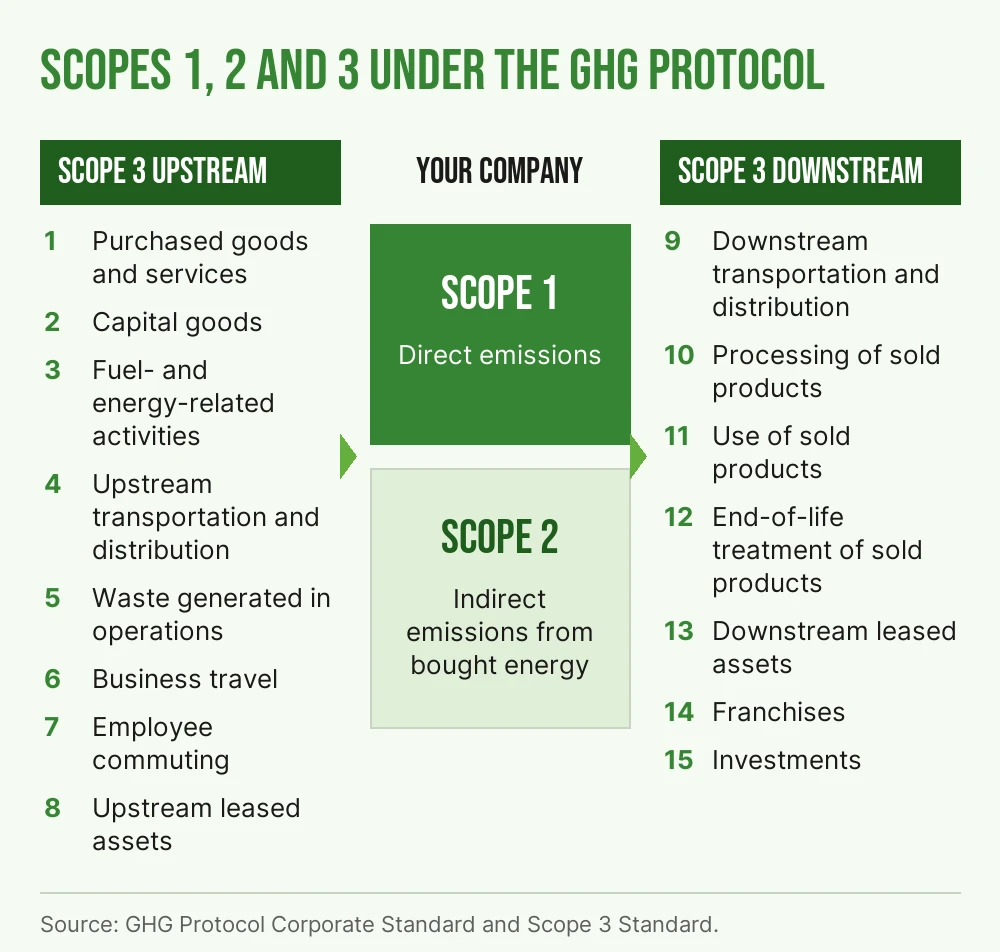
Scope 3 covers all other emissions in the company's value chain. You can split them by direction:
| Direction | Examples |
|---|---|
| Upstream (suppliers) | Production of purchased materials and services, transport, employee commuting |
| Downstream (customers) | Use of products by customers, waste treatment |
Scope 3 is harder to work out and needs help from suppliers and customers. To cut it, choose greener suppliers, improve logistics and sell lower-emission products.
The GHG Protocol standard
 The GHG Protocol comes from two bodies: WRI and WBCSD. It is the international standard for reporting greenhouse gas emissions. It helps companies work out and report their footprint in the same way, so results can be compared.
It also sets rules for the base year, the boundaries, the methods, the emission factors and data quality. An accurate corporate carbon footprint calculation under the GHG Protocol is the key to credible reporting and to managing emissions well.
What data must a corporate carbon footprint report contain?
 A report under the GHG Protocol should contain the data below. Together, they give a full picture of the company's effect on the climate.
1. General information
- The company's details.
- The reporting period.
2. Organisational boundaries
- A description of the group.
- How you add up the group: equity share, operational control or financial control.
- The companies you include and leave out.
3. Operational boundaries
- The scopes covered: Scope 1, Scope 2 and Scope 3, and which Scope 3 categories the report includes. We often prepare one report for Scopes 1 and 2 and a separate one for Scope 3.
- Reasons for any categories left out, above all in Scope 3.
4. Method and data
- Emission sources.
- Data sources.
- The calculation methods used.
- The emission factors used, with their sources.
- The type and quality of data: measured, estimated or missing.
- Assumptions and limits.
5. Results
- Emissions in t CO₂e for Scope 1, Scope 2 (separate results for the location-based and market-based methods) and Scope 3.
- Emissions for each of the seven greenhouse gases separately.
- Total results and results by category.
6. Base year
- Emissions in the base year.
- Whether the base year was recalculated, and why.
- Year-on-year comparisons, if data exists.
7. Reduction actions
- Whether the company has an emission reduction plan and a decarbonisation strategy.
- The reduction actions already taken.
- Whether the reduction targets are science-based and approved, for example by the SBTi.
8. Additional information
- How uncertain the results are.
- External verification, if any.
- Annexes: detailed data, emission factors, invoices and summaries.
How can EXERGY help with your carbon footprint?
We have calculated carbon footprints of companies and products since 2017.
For years we have helped companies measure, understand and cut their greenhouse gas emissions, based on reliable data and recognised standards.
We work under the GHG Protocol and ISO 14064.
We prepare complete carbon footprint reports for organisations, products and services, in Scopes 1, 2 and 3.
We fit the work to your sector and company.
We do not use templates. We choose methods, data and the form of reporting to suit the company and its sector.
We use our own emissions calculation tool.
So the report is complete, clear and ready to submit to reporting platforms without extra corrections.
We help you set realistic reduction targets.
Based on your data, we set the direction of action and help you build a decarbonisation strategy in line with climate targets.