

A carbon footprint is expressed in CO₂ equivalent, even though a company usually emits several greenhouse gases. Examples are carbon dioxide from burning fuels, methane from natural gas leaks, nitrous oxide from fertilisers and refrigerants from air conditioning. Each of them affects the climate with a different strength and for a different time. Methane acts more strongly than CO₂ but breaks down after about 12 years, while CO₂ stays in the atmosphere for centuries. To add these emissions into one result, you must convert every gas into one common unit. This is the main function of the GWP factor. If you want to learn more about how and when we use the GWP factor, read the article below.
- GWP100: the factor that converts a gas into CO₂ equivalent, based on the heat it traps over 100 years.
- CO₂ equivalent (CO₂e): the mass of a gas multiplied by its GWP; 1 tonne of methane from a gas leak is 29.8 t CO₂e.
- GWP in an EPD: the result for a whole product in kg CO₂e, calculated with the same GWP100 factors.
- GWP20: the same factor over 20 years; fossil methane has 82.5 instead of 29.8.
- Corporate carbon footprint: the GHG Protocol and ESRS E1 require GWP100, with values from the latest IPCC report (AR6).
- Refrigerants: the F-gas Regulation uses older IPCC values (AR4) for HFCs, so its tonnes of CO₂e differ from your footprint.
What is GWP100?
 A carbon footprint is the total greenhouse gas emissions caused by an organisation, a product or a service, shown in tonnes of CO₂ equivalent. A corporate carbon footprint covers the seven gases of the Kyoto Protocol. They are carbon dioxide, methane, nitrous oxide, hydrofluorocarbons (HFCs), perfluorocarbons (PFCs), sulphur hexafluoride and nitrogen trifluoride. All of them are converted into CO₂ equivalent with one measure: GWP100.
GWP stands for global warming potential. It compares a greenhouse gas with carbon dioxide (CO₂). It shows how much energy 1 kg of a gas traps in the atmosphere over a set time, compared with 1 kg of CO₂. The number after the letters is that time in years. So GWP100 adds up the effects of an emission over 100 years. For CO₂, the value is always 1.
To get CO₂ equivalent (CO₂e), you multiply the mass of a gas by its GWP. The Intergovernmental Panel on Climate Change (IPCC) publishes these values in its assessment reports. In its sixth report, 1 tonne of methane from a natural gas leak equals 29.8 tonnes of CO₂e. One tonne of nitrous oxide, for example from nitrogen fertilisers, equals 273 tonnes of CO₂e. In this way, you can add the emissions of different gases into one result.
Two features of a gas set its GWP. The first is how strongly it absorbs heat radiation. The second is how long it stays in the atmosphere. Methane absorbs heat much more strongly than CO₂, but it breaks down after 11.8 years on average. Nitrous oxide stays in the atmosphere for 109 years. Tetrafluoromethane (CF₄) from aluminium production stays for 50,000 years (IPCC, 2021).
In practice, the term GWP has two meanings. In a corporate carbon footprint, it is the factor for one gas. In an Environmental Product Declaration (EPD), it is the result for a whole product.
GWP100 as a conversion factor: values from IPCC reports
 The IPCC gives GWP values in its assessment reports and updates them in each new report. It uses newer measurements of how gases absorb heat and how long they stay in the atmosphere. In the sixth report, it also includes the response of the carbon cycle (IPCC, 2021). Laws and carbon footprint reports use four editions. The second report (SAR, 1995) was the basis of the Kyoto Protocol. The others are the fourth (AR4, 2007), the fifth (AR5, 2013) and the sixth (AR6, 2021).
| Gas | SAR (1995) | AR4 (2007) | AR5 (2013) | AR6 (2021) |
|---|---|---|---|---|
| methane (non-fossil in AR5 and AR6) | 21 | 25 | 28 | 27.0 |
| fossil methane | none | none | 30 | 29.8 |
| nitrous oxide (N₂O) | 310 | 298 | 265 | 273 |
| HFC-32 (R-32) | 650 | 675 | 677 | 771 |
| HFC-134a (R-134a) | 1,300 | 1,430 | 1,300 | 1,530 |
| HFC-125 | 2,800 | 3,500 | 3,170 | 3,740 |
| HFC-143a | 3,800 | 4,470 | 4,800 | 5,810 |
| tetrafluoromethane (CF₄) | 6,500 | 7,390 | 6,630 | 7,380 |
| sulphur hexafluoride (SF₆) | 23,900 | 22,800 | 23,500 | 24,300 |
| nitrogen trifluoride (NF₃) | none | 17,200 | 16,100 | 17,400 |
The SAR and AR4 values come from Table 2.14 of the fourth IPCC report. The AR5 and AR6 values come from the GHG Protocol table from 2024.
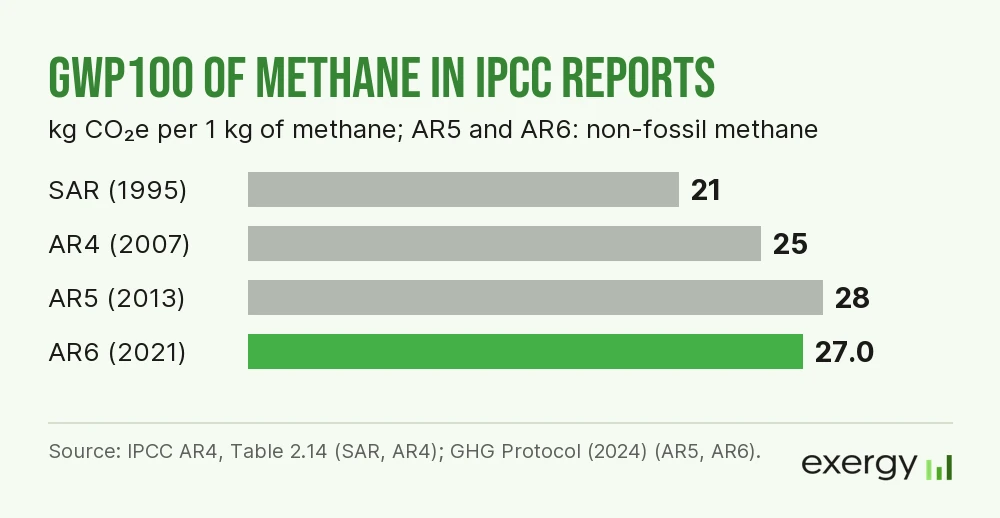
Between the 1995 report and AR6, the GWP100 of nitrous oxide fell from 310 to 273. HFC-32 rose from 650 to 771, and HFC-143a from 3,800 to 5,810. So the same emissions give a different result in each edition. That is why a carbon footprint report always states which IPCC report its values come from.
What does GWP mean in an EPD?
 In an Environmental Product Declaration (EPD), GWP means a result, not a factor. It is the carbon footprint of a product in kg CO₂e per declared unit, for example per tonne of cement. It is shown separately for each life cycle stage, for example production (modules A1–A3). The result is calculated in the same way as a corporate footprint. The emissions of each gas over the life cycle are multiplied by its GWP100 and added up.
The EN 15804+A2 standard for construction products splits this result into four indicators:
- GWP-fossil: emissions from fossil fuels and fossil raw materials.
- GWP-biogenic: uptake and release of biogenic carbon, for example from wood and other biomass.
- GWP-luluc: emissions and removals from land use and land use change.
- GWP-total: the sum of the three indicators above.
The standard refers to the 100-year IPCC model from 2013. The factors come from the EU Environmental Footprint (EF) package. The International EPD System has required version EF 3.1 since 1 September 2024. Some programmes, such as EPD Australasia, add a GWP-GHG indicator. It follows AR5 and leaves out biogenic carbon. EPDs under the older version of the standard, EN 15804+A1, show one GWP indicator.
You may compare two EPDs or use a supplier's result in Scope 3. Then check the version of the standard, the indicator and the life cycle modules. Under the Construction Products Regulation, the carbon footprint of a product will also appear in its declaration of performance and conformity. Our page on the Environmental Product Declaration explains how to prepare an EPD.
GWP100 vs GWP20: what is the difference?
 GWP20 uses the same method as GWP100, but it adds up the effects of an emission over 20 years only. The shorter a gas stays in the atmosphere, the more the time horizon changes the result.
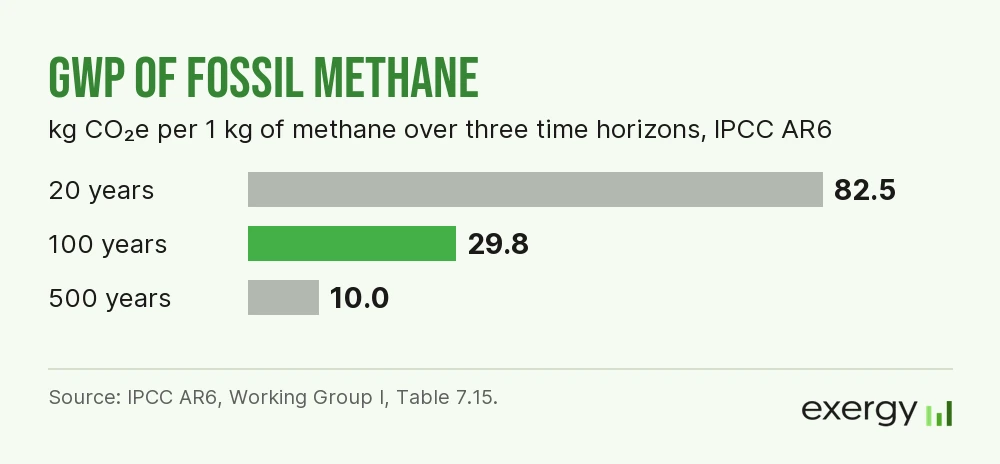
Methane breaks down after about 12 years. So almost all of its effect falls within the first 20 years. Fossil methane has a GWP20 of 82.5, a GWP100 of 29.8 and a GWP500 of 10.0 (IPCC, 2021, Table 7.15).
Nitrous oxide stays in the atmosphere for more than 100 years. It has the same value over both horizons: 273. For very long-lived gases, the pattern goes the other way. CF₄ has a GWP20 of 5,301 and a GWP100 of 7,380. CF₄ keeps its effect for thousands of years, while the effect of CO₂, the reference gas, gets weaker over time.
| Gas | Lifetime in the atmosphere | GWP20 | GWP100 |
|---|---|---|---|
| carbon dioxide (CO₂) | no single value | 1 | 1 |
| fossil methane (CH₄) | 11.8 years | 82.5 | 29.8 |
| non-fossil methane (CH₄) | 11.8 years | 79.7 | 27.0 |
| nitrous oxide (N₂O) | 109 years | 273 | 273 |
| HFC-32 (refrigerant R-32) | 5.4 years | 2,693 | 771 |
| tetrafluoromethane (CF₄) | 50,000 years | 5,301 | 7,380 |
Neither time horizon is more accurate than the other. The IPCC does not recommend one metric. The right choice depends on the purpose of the comparison and on the time period that matters to the user.
When is GWP20 used?
 GWP20 is used mainly in scientific studies. They assess how an activity affects warming in the next few decades, above all when methane is a large part of its emissions. Examples:
- Exports of liquefied natural gas (LNG): Howarth (2024) counted methane leaks in production, liquefaction and shipping. Over 20 years, LNG from the USA had a footprint one third larger than coal. Over 100 years, it was equal to coal or larger.
- Blue hydrogen: Howarth and Jacobson (2021) used GWP20 for hydrogen made from natural gas with CO₂ capture. Its footprint was more than 20% larger than burning gas or coal for heat. Other researchers said the assumed methane leak, 3.5% of production, was at the top of the estimates (Romano and others, 2022).
- Stable methane emissions, for example from a herd of constant size: the IPCC (2021) found that GWP20 matches warming for a few decades. After that, it overstates it. GWP100 overstates the effect of stable methane emissions 3 to 4 times. It understates the effect of a new source 4 to 5 times in the first 20 years.
- Reporting practice: Ocko and others (2017, Science) propose to always show GWP20 and GWP100 together as a pair. Then decision makers see the effects over both time horizons.
Newer metrics described by the IPCC, such as GWP*, show better how stable or falling methane emissions affect temperature. But reporting standards and laws stay with GWP100. They give GWP20 only next to it, for information, as the F-gas Regulation does.
In a corporate carbon footprint, GWP20 does not replace GWP100. The GHG Protocol requires 100-year IPCC values. ESRS E1 requires the latest values over the same time horizon. A company with large methane emissions, for example from livestock, a landfill or a gas network, can show a GWP20 result separately. Put it next to the main result and describe the method.
Which GWP100 values should you use in a carbon footprint: AR4, AR5 or AR6?
 Corporate carbon footprints today use three sets of values: AR4, AR5 and AR6 (see the table in the section on values from IPCC reports). Since 2013, the GHG Protocol Corporate Standard has set five conditions:
- Time horizon: use 100-year IPCC values.
- Report edition: the latest IPCC report is recommended, and an older one is allowed.
- One report: use values from the same edition for all gases in one inventory, unless a gas is missing from it.
- Consistency over time: use the same values for the current year, the base year and Scope 3.
- Disclosure: state the source of the GWP values and say if you used more than one edition.
In August 2024, the GHG Protocol updated its table of GWP values. It now recommends AR6. ESRS E1 requires the latest IPCC values over 100 years. Today, this means AR6.
AR6 has separate values for fossil methane (29.8) and non-fossil methane (27.0). Under the GHG Protocol, the fossil value applies only to fugitive emissions from fossil fuels. Examples are leaks from gas networks and coal mines, and industrial processes that use fossil carbon. Methane from burning fuels, including fossil fuels, and from biological sources uses 27.0. Otherwise, the CO₂ formed when methane breaks down would count twice. The CO₂ from burning the fuel is already in the result.
If you change GWP values during reporting, recalculate the base year when the change is above the significance threshold in your recalculation policy. If you do not, a fall or rise in emissions will come from new values, not from your actions. Recalculation is simple if you kept past data for each gas. Multiply the masses of methane, nitrous oxide and F-gases by the new values. It is harder if your spreadsheet only shows tonnes of CO₂e.
Emission factors from different sources: AR4, AR5 and AR6 in one report
 The GWP set in your report does not always match the set behind your emission factors. Common sources use different IPCC editions:
- UK government conversion factors (DESNZ): the 2026 edition mostly uses AR5; some factors, for example upstream emissions of bioenergy, still use AR4.
- National inventories: EU countries report with AR5 (methane 28, nitrous oxide 265) under the Paris Agreement rules and Delegated Regulation (EU) 2020/1044.
- F-gas Regulation: hydrofluorocarbons (HFCs) with AR4, other fluorinated gases with AR6.
- Grid electricity factors for CO₂ only: the choice of IPCC edition does not change them.
You can convert a factor to AR6 if it is given for each gas separately, like the DESNZ factors for fuels. Multiply the methane and nitrous oxide emissions by the new values. You cannot convert a factor that is given only in kg CO₂e. In that case, the GHG Protocol lets you keep it. But your report must say that it uses values from more than one IPCC edition.
When you burn fuels, methane and nitrous oxide are a small part of the emissions. So the IPCC edition changes the result very little. The differences grow where gases other than CO₂ dominate: refrigerants, agriculture and waste.
Refrigerants: GWP in the F-gas Regulation and in your carbon footprint
 A refrigerant leak from air conditioning, a cold store or a heat pump is part of Scope 1. The easiest way to find the size of a leak is the equipment record. Under Article 7 of Regulation (EU) 2024/573, operators must record how much gas they add during servicing and after a leak.
But the regulation calculates tonnes of CO₂ equivalent with other values than your carbon footprint. For hydrofluorocarbons, it uses GWP100 from the fourth IPCC report. This keeps it consistent with the Montreal Protocol. For other fluorinated gases, it uses the sixth report. The amount of gas in the equipment, calculated this way, sets how often you must check it for leaks:
- 5 to 50 tonnes of CO₂ equivalent: at least every 12 months, or every 24 months with a leak detection system;
- 50 to 500 tonnes: every 6 months, or every 12 months with leak detection;
- 500 tonnes or more: every 3 months, or every 6 months with leak detection.
In your carbon footprint, use the GWP set chosen for the whole report, usually AR6. For a mixture, the GWP is the average of its components weighted by mass, as in Annex VI of the regulation. R-404A is common in commercial refrigeration. It is 44% HFC-125, 52% HFC-143a and 4% HFC-134a. One kilogram of this mixture equals:
- 3,922 kg CO₂e with AR4, as in the F-gas Regulation;
- 3,943 kg CO₂e with AR5, as in the DESNZ 2026 factors;
- 4,728 kg CO₂e with AR6.
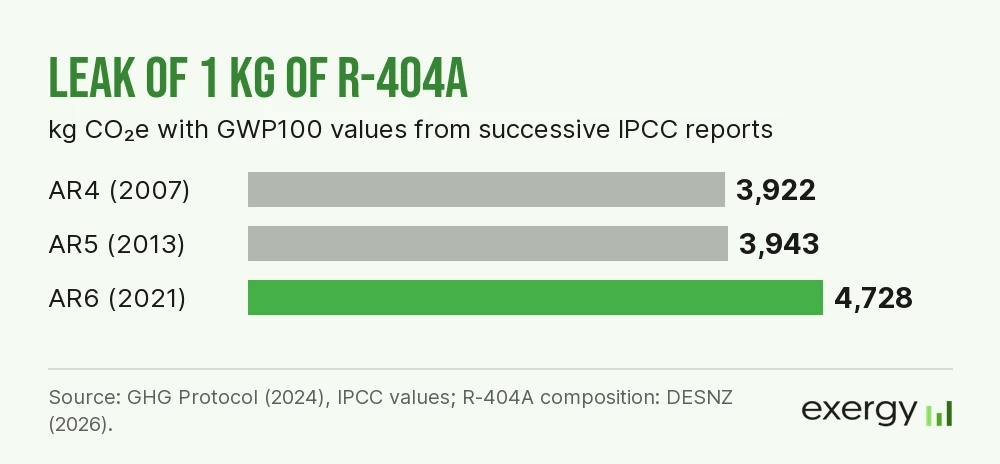
For a leak of 10 kg of R-404A, the gap between the regulation and an AR6 footprint is 8.1 tonnes of CO₂e. For leak checks, always use the values from the regulation. In your carbon footprint, convert the same kilograms with the values chosen for the report.
How to describe GWP in a carbon footprint report?
 The methodology section of a carbon footprint report should give five facts about GWP values:
- Source of values: the IPCC report edition, for example AR6, and the table used, or the GHG Protocol table from 2024.
- Time horizon: 100 years; a GWP20 result, if the report has one, is shown separately.
- Methane: whether fossil and non-fossil methane are separated, and which sources use each value.
- Factors from other editions: a list of emission factors based on AR4 or AR5 that could not be converted.
- Base year: whether it was recalculated with the same GWP values.
A carbon footprint verification checks these points. Different GWP values in the base year and the current year change the reduction result, even when emissions stay the same. To see where to find data for Scopes 1, 2 and 3, read how to calculate a company's carbon footprint step by step.