
A customer asks for your carbon footprint, and you are not sure what exactly they want. Large companies that ask their suppliers about the carbon footprint usually expect one of two things. They want the footprint of your whole company and your plans to reduce it. Or they want the footprint of the products they buy from you.
- Corporate vs product carbon footprint: the first covers your whole company in a year, the second one product over its life cycle.
- Corporate footprint: Scopes 1, 2 and 3 under the GHG Protocol or ISO 14064-1.
- Product footprint: life cycle stages, from gate to gate up to cradle to grave, under ISO 14067.
- Obligations: the CSRD asks the largest companies for a corporate footprint; CBAM puts a price on the embedded emissions of some imported goods.
What is a carbon footprint?
 The greenhouse effect makes life on Earth possible. Greenhouse gases keep in the atmosphere part of the heat that comes from the Sun. Thanks to this, our planet has the right temperature for nature to develop.
Global warming is the growth of this greenhouse effect, and it is dangerous for our civilisation. It happens because the amount of greenhouse gases in the atmosphere rises. Human activity is the main cause of this rise.
This is what a carbon footprint measures: the greenhouse gas emissions caused by a human activity, such as running a company or making a product. A carbon footprint covers seven greenhouse gases: CO₂, CH₄, N₂O and a group of four fluorinated gases.
Together, these gases are expressed as CO₂e (carbon dioxide equivalent). A carbon footprint shows nothing else. It tells you nothing about smog, soil or water pollution, dust or acid rain. It shows only the effect on the climate, that is, on the greenhouse effect of the Earth. For a wider view, see our guide to Scope 1, 2 and 3 emissions.
Corporate carbon footprint
 Let us start with the corporate carbon footprint. Under the most common method, the GHG Protocol Corporate Standard, it has three scopes:
- Scope 1, direct emissions: fuel burnt in the company's own heat sources and in its vehicles, such as cars, forklifts, and even boats and planes.
- Scope 2, indirect energy emissions: electricity, and heat or cooling from a network, bought from outside suppliers.
- Scope 3, value chain emissions: 15 categories in two groups, upstream and downstream. In short, upstream (categories 1 to 8) covers emissions linked to the company's costs. Downstream (categories 9 to 15) covers emissions linked to its revenue.
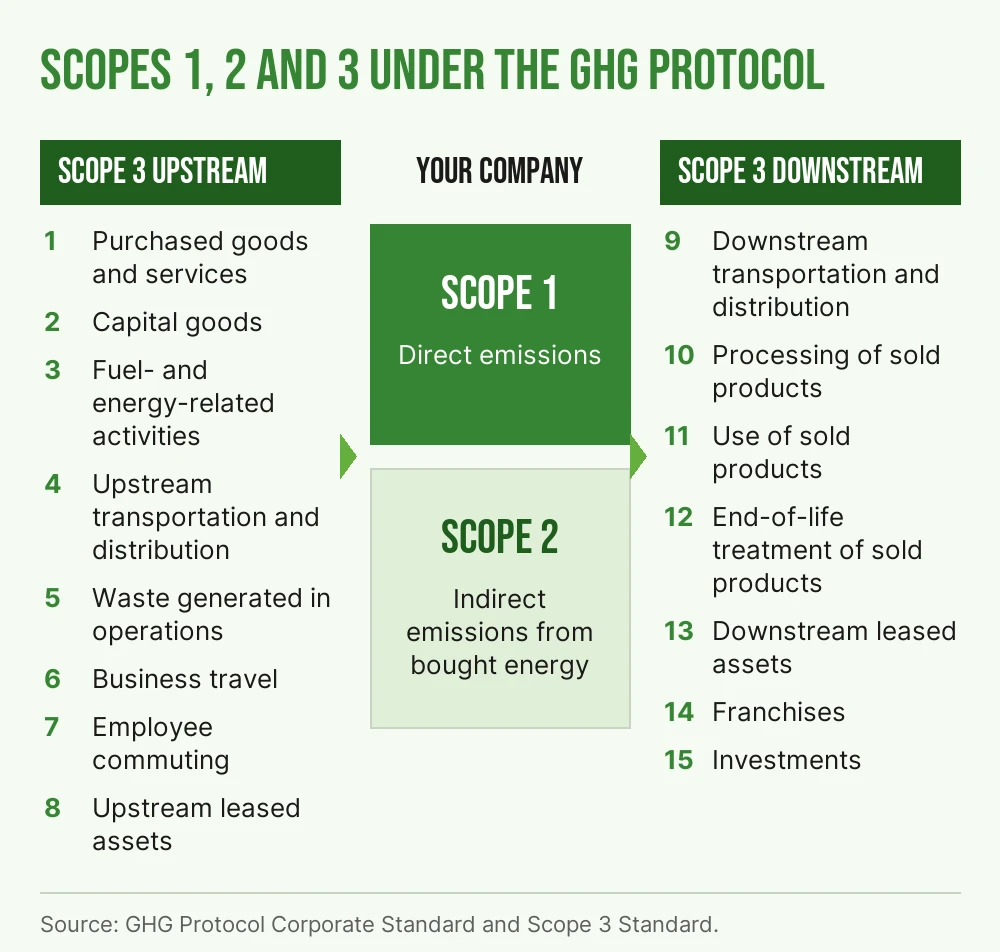
Under the GHG Protocol, Scopes 1 and 2 are required, and Scope 3 is optional for most companies. For most industrial companies, Scope 3 is a big and difficult task. Scope 3 is usually the largest part of the footprint. But without it, it is hard to manage your climate impact in a sustainable way. See also how to calculate a company's carbon footprint.
Product carbon footprint
 A product carbon footprint is different. It covers the emissions from making and using one product, or a group of very similar products. We explain the calculation step by step in how to calculate a product carbon footprint. Companies often start this work only after they have calculated at least Scopes 1 and 2 of their corporate footprint.
You calculate a product footprint over the product life cycle with the LCA method (life cycle assessment), for the stages you choose:
- Gate to gate: only the emissions from the production process. In short, the company's Scopes 1 and 2 divided by the number of products made.
- Cradle to gate: also raw materials bought, their delivery, the production stages and packaging. This is the most common scope in business-to-business communication.
- Cradle to grave: also transport to the customer, and the emissions from use and disposal. This is the full life cycle of the product.
- Cradle to cradle: goes beyond the life of the product. It looks at the benefits of new raw materials made from the old product.
How does a corporate carbon footprint differ from a product carbon footprint?
 The table compares the two footprints side by side.
| Area | Corporate carbon footprint | Product carbon footprint |
|---|---|---|
| Covers | the whole company or group of companies | one specific product or product group |
| Scope | Scopes 1 and 2 (the company only) or Scopes 1 to 3 (with the value chain) | gate to gate, cradle to gate, cradle to grave or cradle to cradle |
| Uncertainty assessment | voluntary | required |
| How often | usually once a year | usually once every few years |
| Cost | Scopes 1 and 2: low; Scopes 1 to 3: fairly high | fairly high, depending on the number of products |
| Use | sustainability reports, ratings such as EcoVadis or CDP, data for customers who calculate their Scope 3 | carbon labels on products, data for customers who calculate the footprint of their products or their Scope 3 |
| Example of reduction | less electricity use thanks to LED lighting; electricity with guarantees of origin | switching to raw materials with a lower carbon footprint |
Why did my customer ask me for my carbon footprint?
 Large companies now include the environment in their plans, and they pass these demands on to their suppliers. Customers, investors and EU law all play a part. Here are some examples:
- Sustainability reporting: in the EU, large companies report their climate impact, sometimes including their supply chain. Their questions to suppliers follow from this.
- Climate neutrality targets: many large companies have set climate neutrality targets. Their plans include cutting emissions in their own supply chain.
- Rules for construction: in many EU countries, new buildings need a carbon footprint. The EU Energy Performance of Buildings Directive extends this to all new buildings from 2030. To calculate the carbon footprint of a building, you need data on the products used to build it.
- Competitive advantage: companies want to stand out with a lower carbon footprint of their products. This is not possible without reliable data from their suppliers.
Which standards do you use to calculate and report a carbon footprint?
 Different standards apply to calculating and reporting a carbon footprint of activities, products or organisations. These are the most common:
- Greenhouse Gas Protocol (GHG Protocol): the most widely used method in business. Two organisations created it: the World Resources Institute (WRI) and the World Business Council for Sustainable Development (WBCSD). It sets standards for organisations (Corporate Standard) and for products (Product Life Cycle Standard).
- ISO 14064: an international standard on how to measure, monitor and report greenhouse gas emissions. It has three parts: ISO 14064-1 (organisations), ISO 14064-2 (reduction projects) and ISO 14064-3 (validation and verification of emissions).
- ISO 14067: a standard for the carbon footprint of products, over the product life cycle.
- PAS 2050: a specification from the British Standards Institution (BSI) for products and services. It covers stages such as production, distribution, use and disposal.
Is calculating a corporate or product carbon footprint mandatory?
 The answer is: it depends. From financial year 2027, the CSRD covers companies with more than 1,000 employees and more than EUR 450 million net turnover. They report under the European Sustainability Reporting Standards (ESRS). Climate change may be material for the company. Then the ESRS E1 standard requires its corporate footprint in Scopes 1 and 2. It also requires Scope 3 for each significant category. The ESRS do not require product footprints.
Product footprints matter for importers under the EU Carbon Border Adjustment Mechanism (CBAM). From 2026, importers of cement, iron and steel, aluminium, fertilisers, electricity and hydrogen pay for the emissions embedded in these goods through CBAM certificates.