

Most companies start their carbon footprint with their own sites, fuels and electricity. Companies that report to CDP measure these direct emissions twice as often as their supply chain emissions. Yet in their 2023 data, supply chain emissions were on average 26 times higher (CDP and BCG, 2024). Your larger customers ask you for this data. They report Scope 3 under the CSRD and track it against their climate targets.
- How to calculate a company's carbon footprint: multiply activity data by an emission factor for each source in Scopes 1, 2 and 3.
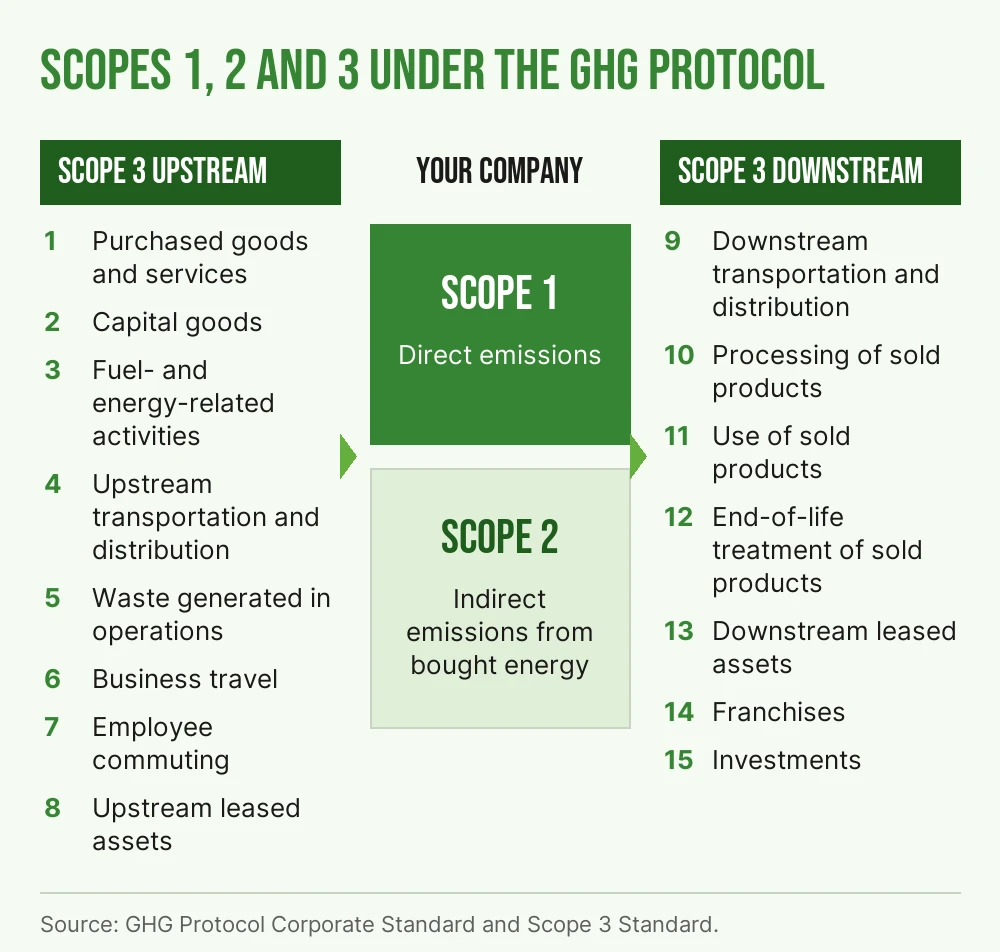
- Scope 1: direct emissions from your fuels, vehicles, processes and refrigerant leaks.
- Scope 2: emissions from the electricity and heat you buy, shown with two methods.
- Scope 3: all other emissions in your value chain, often the largest part.
Scope 1: direct emissions
Definition
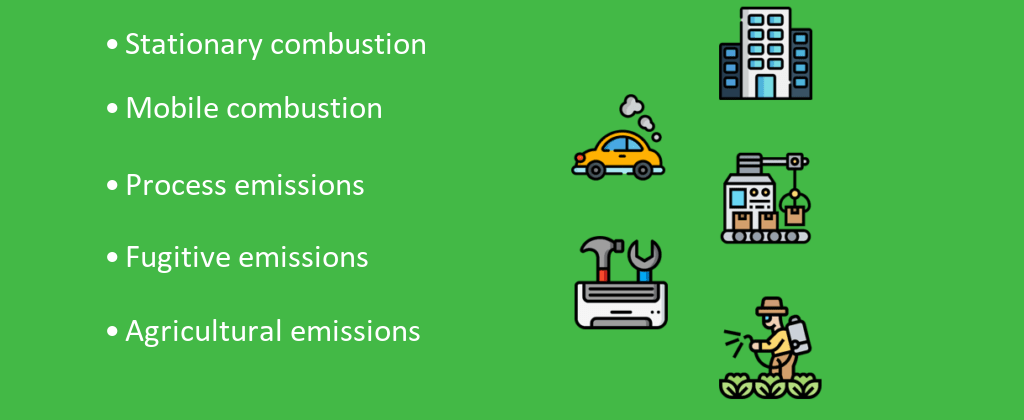
Scope 1 covers direct greenhouse gas emissions from sources that your company owns or controls. It includes five categories:
- Stationary combustion: fuels burned for heating and in production.
- Mobile combustion: fuels burned by vehicles that your company owns or controls.
- Process emissions: gases from production processes, for example welding, electrolysis or packaging.
- Fugitive emissions: leaks of refrigerants from cooling and air conditioning, or of gas from pipelines.
- Agricultural emissions: emissions from farming activities.
From financial year 2027, the CSRD requires emissions reports from large companies. These are companies with more than 1,000 employees and more than EUR 450 million net turnover. The Omnibus I directive of February 2026 made this group smaller. These companies disclose emissions under the ESRS E1 standard. Read more about the corporate carbon footprint and how to report it.
Sources of Scope 1 emissions
Scope 1 sources differ between companies. These are the most common:
Burning fossil fuels at your sites
This mainly means natural gas or heating oil. You burn it in boilers, furnaces, generators and engines, for heating or in production.
Company vehicles
These emissions come from car fleets, lorries, farm machines and construction vehicles. Leased vehicles count too if your company pays for the fuel.
Industrial processes
Chemical, metal and production processes can release CO₂, methane, nitrous oxide or other greenhouse gases. You find them most often in cement, glass, steel and chemical production.
Gas leaks
Refrigerant leaks are a common source. They happen during maintenance or when cooling and air conditioning equipment breaks down.
Crops and livestock
If your company works in agriculture, emissions include methane and nitrous oxide from animals. They also include emissions from fields, linked to fertilisers and how you manage them.
How to calculate Scope 1 emissions?
To calculate Scope 1, you need to know your emission sources and use the right method.
Step 1: Find your emission sources
Check what can cause emissions in your company. Ask a few simple questions. Do you have boilers or furnaces that burn fossil fuels? Do you have a vehicle fleet? Do service reports show refrigerant leaks? Do you run production processes? The answers show where your emissions come from.
Step 2: Collect data on what you used
Next, collect data on how much you used. This includes fuel for heating and for company vehicles, gases used in processes and refrigerants lost. Use reliable data, such as fuel invoices, meter readings or service reports for cooling equipment.
Step 3: Choose the right emission factors
An emission factor shows how much greenhouse gas one unit of fuel, material or product releases. It turns your data on use into emissions. This is why the choice of emission factor matters so much.
Step 4: Calculate the emissions
The calculation itself is simple:
activity data × emission factor = carbon footprint
Step 5: Analyse the result and report
Compare the results with earlier years or with your targets. Find areas where you can save energy or change something. Then prepare a report on your Scope 1 and 2 results. Include the emissions data, the calculation method and ideas for cutting emissions. For a fully credible result, consider an independent verification of your carbon footprint.
Scope 2: indirect emissions from energy
Definition
Scope 2 covers indirect emissions from the energy that your company buys. The emissions happen at the power plant or the heating plant, not at your site.
Sources of Scope 2 emissions
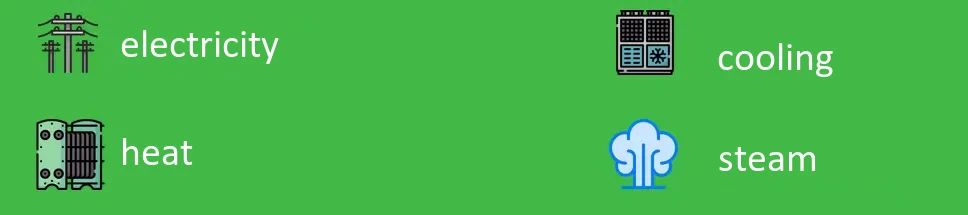
Most companies have four possible sources: electricity, heat, cooling and steam.
How to calculate Scope 2 emissions?
You calculate Scope 2 emissions with two methods: location-based and market-based.
How are they different?
The location-based method uses average emission factors for the grid in your region. It does not depend on the energy source that your company chooses.
The market-based method uses your actual contracts and the energy sources of your supplier. It also counts your own actions, for example buying renewable energy with guarantees of origin.
In short, the location-based method shows the local, national energy mix. The market-based method shows your company's choices on the market.
These steps help you calculate your Scope 2 footprint:
Step 1: Find your energy sources
List the types of energy that your company buys. For example, electricity, heat or steam.
Step 2: Collect data on energy use
Collect the total amount of energy you bought from each source. You find it on invoices or in energy management systems. Use the same unit for each type, for example kWh for electricity and GJ for heat.
Step 3: Choose the right emission factor
Choose a CO₂ emission factor for each type of energy. Depending on the method, use factors from your energy supplier or national factors.
Step 4: Calculate
The calculation itself is simple:
activity data × emission factor = carbon footprint
Step 5: Analyse the result and report
Check the results and compare them with earlier periods. Find the areas with the highest emissions and where you can improve. Then prepare a report with the results, the calculation methods and ideas for cutting emissions.
Scope 3
Scope 3 covers indirect emissions in your value chain. For example, from purchased materials, waste, business travel or the use of your products. Scope 3 is harder to measure and to control. But it is often the largest part of a company's emissions.
Read more in our article on Scope 3 emissions of an organisation.
Which standard should you use?
GHG Protocol: the main standard
The Greenhouse Gas Protocol is the global standard for counting company emissions. Companies use it all over the world. This lets you compare emissions data between companies and sectors. Many other programmes build on it, for example Science Based Targets, CDP and ISO standards for environmental management.
The World Resources Institute (WRI) and the World Business Council for Sustainable Development (WBCSD) developed the GHG Protocol. Companies, public bodies and governments use it to measure and manage their emissions.
Changes to the GHG Protocol (2026–2028)
The standard behind Scopes 1, 2 and 3 now has its biggest update in years. Today, three documents apply: the Corporate Standard from 2004, the Scope 2 Guidance from 2015 and the Scope 3 Standard from 2011. Reports based on them stay fully valid. Three things will change:
- New Scope 2 rules: the GHG Protocol asked for public comments from 20 October 2025 to 31 January 2026. It got about 1,100 responses from 56 countries. It proposed hourly matching of certificates with energy use. Certificates should also come from the same market. In Europe, this means the same bidding zone. The location-based method gets a new order of factors. Companies will still report both methods.
- One standard with ISO: on 29 July 2026, the GHG Protocol and ISO announced one joint standard. It will merge the updated corporate standards, including the Scope 2 and Scope 3 rules, with ISO 14064-1.
- Dates: a joint draft goes to public consultation in the second quarter of 2027. Publication is planned for the fourth quarter of 2028. The date when it applies is not known yet.
What does this mean for you? You do not need to change your current calculations. But you should start collecting hourly energy data now. Also check where the guarantees of origin behind your market-based result come from. Read more in our article on the alignment of ISO and the GHG Protocol and the new Scope 2 rules.
Next steps: cutting emissions
Towards net zero: how to cut emissions
Reducing your carbon footprint means more than monitoring emissions. Calculating your footprint is the first step. After that, your company can also act on its product carbon footprint and on its daily activities.
Your results help you set clear targets to cut emissions. You can measure progress against them. These targets can be part of a wider climate goal, such as net zero. They can also support the Paris Agreement. Customers and investors look at emissions, so lower emissions can help you win business. If you prefer to work with experts, you can ask us to calculate your company's carbon footprint.
Investments in energy efficiency
Find the areas that use the most energy and the places where you lose it. Then plan investments that cut energy use, for example better insulation, efficient motors or heat recovery. Measure your energy use often. Then you see the effect of each change.
Renewable electricity (guarantees of origin)
To reduce your footprint, your company can buy electricity that comes 100% from renewable sources. Guarantees of origin confirm that the energy came from renewable sources. This lowers the emissions from the electricity you buy. You can also sign a long-term contract to buy electricity directly from a renewable energy producer (PPA). Such a contract can also bring financial benefits.
Replacing equipment with low- or zero-emission options
New, efficient equipment uses much less energy than old equipment, so emissions go down. Consider equipment that runs on renewable electricity. Where possible, invest in zero-emission technology. For example, heat pumps use electricity instead of fossil fuels to heat buildings.
Switching to refrigerants with lower emissions (for example R513A instead of R134a, or propane-based refrigerants)
Some refrigerants have a high global warming potential (GWP). In cooling and air conditioning, you can replace them with better options. For example, R513A has a lower GWP than R134a. You can also consider refrigerants based on propane, a natural gas with a very low GWP.
Moving heat sources from fossil fuels to electricity and renewables
Heat pumps and other electric heating can replace fossil fuel boilers. Together with renewable electricity, this cuts emissions a lot. It works best when the energy comes from certified renewable sources. You can also connect the heating system to your own solar panels and use your own electricity for heating.
Training employees to save energy
In small and medium-sized companies, you can start with small steps. Regular training on saving energy can cut energy use at work. For example, staff can switch off equipment after work, avoid unnecessary lighting and use air conditioning with care. Short internal campaigns help too. They show staff how these actions help the climate.