

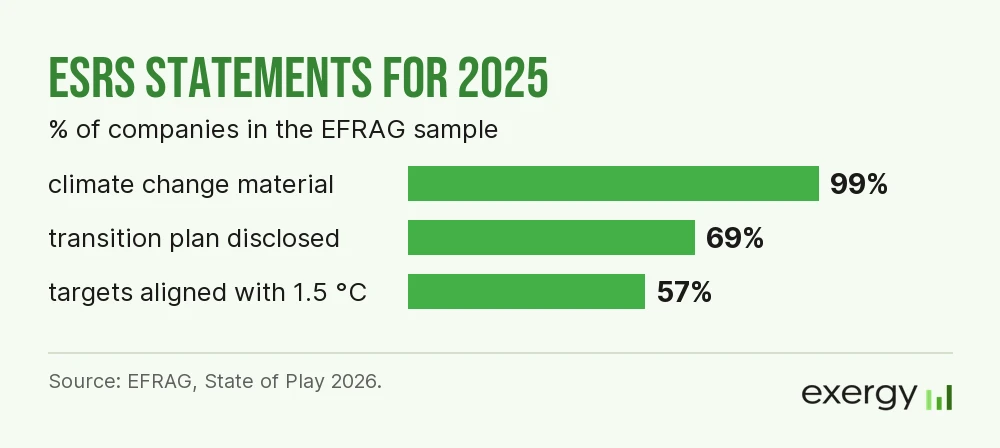
In their ESRS statements for 2025, 99% of companies in the EFRAG sample found climate change to be material. Only 57% disclosed near-term and long-term targets in line with 1.5°C (EFRAG, State of Play 2026). From financial year 2027, companies under the CSRD will report on climate under a revised ESRS E1, with more requirements and new numbers.
- ESRS E1 standard: from financial year 2027, it has 11 disclosure requirements, from the transition plan (E1-1) to the financial effects of risks (E1-11).
- New numbering: the former E1-2 to E1-9 now have numbers two higher; greenhouse gas emissions are now E1-8.
- New E1-2 and E1-3: climate risk identification, scenario analysis and resilience moved into E1 from ESRS 2.
- Data removed: the total of Scope 1, 2 and 3 emissions, and emission and energy intensity per net revenue.
Who must apply ESRS E1, and when does the new version apply?
 The ESRS, or European Sustainability Reporting Standards, are based on the CSRD. A company applies E1 Climate change if it must report on sustainability and finds climate change material. So the double materiality assessment decides whether E1 goes into the report. The company then shares only material data, not every data point in the standard.
The Omnibus I Directive (EU) 2026/470 of 24 February 2026 narrowed the group of companies under the CSRD:
- from financial year 2027: the duty applies to companies that have more than 1,000 employees on average and more than €450 million in net turnover;
- wave one companies: companies that have reported since 2024 but are below the new thresholds. They may skip their statements for 2025 and 2026 if their EU country allows it;
- national law: EU countries must put the new thresholds into their law by 19 March 2027.
Commission Delegated Regulation (EU) 2026/1563 with the new ESRS applies from 10 November 2026. Companies use the revised standards for financial years starting on or after 1 January 2027.
| Date | What happens |
|---|---|
| 24 February 2026 | Omnibus I Directive (EU) 2026/470 |
| 3 July 2026 | the Commission adopts the new ESRS |
| 10 November 2026 | Delegated Regulation (EU) 2026/1563 applies |
| 1 January 2027 | first financial year under the new ESRS |
| 19 March 2027 | deadline to put the new thresholds into national law |
Transition rules make the first years easier:
- E1-11 for wave one: companies above the new thresholds may skip financial effects for years before 2028, and quantitative data for years before 2030;
- E1-11 for companies reporting from 2027: they may skip financial effects in the first two years and quantitative data in the first four;
- exception to both reliefs: from year one, you report the book value of assets exposed to material risks. You also report the part covered by actions;
- value chain: for the first three years, a company may lack data from suppliers or customers. It then describes its efforts, the reasons for the gaps and its plans to fill them.
What changed in ESRS E1 in 2026?
 The new ESRS E1 has 11 disclosure requirements instead of 9. Two of them moved from ESRS 2: risk identification with scenario analysis, and resilience. So the old numbers in ESRS E1 changed.
| ESRS E1 from 2027 | Disclosure requirement (short name) | ESRS E1 of 2023 |
|---|---|---|
| E1-1 | Transition plan | E1-1 |
| E1-2 | Climate risks and scenario analysis | ESRS 2 IRO-1 |
| E1-3 | Resilience | ESRS 2 SBM-3 |
| E1-4 | Policies | E1-2 |
| E1-5 | Actions and resources | E1-3 |
| E1-6 | Targets | E1-4 |
| E1-7 | Energy use and mix | E1-5 |
| E1-8 | Gross Scope 1, 2 and 3 emissions | E1-6 |
| E1-9 | Removals and carbon credits | E1-7 |
| E1-10 | Internal carbon pricing | E1-8 |
| E1-11 | Financial effects of risks and opportunities | E1-9 |
With the 2026 changes, these data are no longer mandatory:
- total of Scope 1, 2 and 3 emissions: you no longer disclose the total. You still report each scope separately, and Scope 3 for each significant category (E1-8);
- emission intensity: you no longer give emissions per net revenue. You still disclose absolute emissions, and a target set in intensity also needs absolute values (E1-6);
- energy intensity: you no longer give energy use per net revenue. You still disclose total energy use in MWh, split into fossil, nuclear and renewable sources (E1-7);
- EU taxonomy in the transition plan: you no longer refer to taxonomy-aligned capital spending. You still show how much you spent and plan to spend on the plan (E1-1);
- EU climate benchmarks: you no longer state whether you are excluded from Paris-aligned benchmarks. You still give capital spending on coal, oil and gas, if you have any (E1-1);
- target years: you no longer must set targets for 2030 and 2050 or update the base year every five years. You choose both years yourself. You keep the base year unless the target or the boundary changes a lot (E1-6).
Let us now go through the chapters of ESRS E1 one by one.
ESRS E1-1: transition plan for climate change mitigation
 In E1-1, you describe your transition plan, in practice your decarbonisation plan. You show how your company will change so that emissions fall fast enough to limit warming to 1.5°C. The end point is climate neutrality, which the EU has set for 2050. You describe the plan in five points:
- key features of the plan: reduction targets, decarbonisation levers, actions, investments and their funding. Also board approval and the link to company strategy;
- spending on coal, oil and gas: amounts invested in such activities in the reporting period, if you have any;
- assumptions and dependencies: for example, the availability of technology and staff, or changes at suppliers that the plan depends on;
- locked-in emissions: a qualitative assessment of whether future emissions from key assets and products could put the plan at risk and raise transition risk;
- progress: every year, you show how much you spent on the plan and what you did. You also show how far emissions have fallen and how far they still must fall. Where possible, add sector indicators, such as emissions per tonne of product.
The ESRS do not require you to have a transition plan. They only require you to disclose the facts. If you have no plan with the elements above, say so and state whether and when you will adopt one. The same applies to 1.5°C: if your targets are not in line with it, say so and explain how they compare with the reference value. You do not need to disclose the details you use to manage the plan internally.
To prepare a transition plan, you need the targets you disclose in E1-6 and the list of actions from E1-5. We describe how to build such a plan step by step in the article How to reduce your business carbon footprint in seven steps.
Some figures to end this chapter. According to EFRAG, 69% of companies in its sample disclosed a transition plan in their statements for 2025, up from 55% a year earlier. 99% found climate change to be material, and 57% disclosed near-term and long-term targets in line with 1.5°C (EFRAG, State of Play 2026).
ESRS E1-2: climate risk identification and scenario analysis
 E1-2 explains how you find and assess the climate risks and opportunities that matter financially. You assign each material climate risk to physical risks or to transition risks. You also describe how you check whether your assets and activities are exposed to the following. This covers your own operations and the value chain, in the short, medium and long term:
- physical climate hazards: for example, heatwaves, droughts, floods and heavy rain;
- transition events (law, market): for example, new laws, carbon prices, and changes in technology and demand.
The 2023 version of the ESRS asked you to explain how you used scenario analysis. The new version says that you “may” use it.
If you do, you disclose:
- scenarios: whether you used at least one high-emission scenario for physical risks and a 1.5°C scenario for transition risks, and the temperature outcomes they match;
- scope: the locations and entities covered by the analysis;
- assumptions: for example, public policies, macroeconomic trends, the energy mix and technology development;
- timing: when you carried out the analysis.
We show how to go through this process in the article on climate risks and opportunities.
ESRS E1-3: resilience in relation to climate change
 E1-3 follows on from E1-2: the resilience analysis starts from the risks reported there. Here, you show how ready your strategy and business model are for material climate risks, and whether they can adapt.
The reporting company discloses three areas:
- results of the analysis: what effects climate risks have on the strategy and business model. Also how the transition plan and the actions in E1-5 make the company more resilient;
- areas of uncertainty: which parts of the assessment remain uncertain, for example future carbon prices or the scale of weather events in the scenarios;
- ability to adapt: whether there will be enough funding over time. Also whether assets at risk can be moved, upgraded, used for another purpose or shut down.
You do not need to repeat the analysis every year. You update it when the risk assessment in E1-2 changes. Banks and insurers can reuse what they already prepare for their supervisors, such as their own scenario analyses.
ESRS E1-4: climate change policies
 E1-4 describes your climate policy: your rules on cutting emissions and on adapting to climate change. It can be a separate climate policy, or an environmental or energy policy that already covers these issues.
You describe it under the general rules of ESRS 2 (GDR-P), in three points:
- content: the aims of the policy and the material impacts, risks or opportunities it covers. If you changed the policy in the year, describe the changes;
- scope: whether the policy covers your own operations and the value chain, which regions it applies to and what it excludes;
- standards and initiatives: list the external standards or initiatives the policy refers to, such as ISO 14001, ISO 50001 or the SBTi.
A climate policy is not mandatory. If you do not have one, it is enough to disclose that. The 2023 version of the ESRS also asked whether the policy covered energy efficiency and renewable energy. This requirement is gone.
ESRS E1-5: actions and resources on climate change
 In E1-5, you describe what your company does to cut emissions and prepare for climate change. You also say how much it spends on this. You show separately what you did in the reporting year and what you plan for the next years.
For the reporting year:
- actions: what you did, in which sites or processes, and with what effect;
- spending: if the amounts are significant, how much you spent on these actions and where they appear in the financial statements;
- emission cuts: for actions that cut emissions, how far emissions have already fallen, split by decarbonisation lever.
For the next years:
- plans: what you intend to do, where, by when and with what expected effect;
- budget: an indicative range of the amounts you plan to spend;
- expected emission cuts: how far emissions should fall once the plans are carried out, also split by lever.
A decarbonisation lever is an area where you cut emissions. Examples include:
- energy efficiency and lower energy use;
- efficient use of materials and lower material use;
- fuel switching;
- electrification;
- renewable energy;
- phasing out, replacing or changing a product or process.
If your plans depend on outside conditions, such as grants or changes in the law, disclose this. If you have no actions, it is enough to disclose that.
ESRS E1-6: targets related to climate change
 In E1-6, you disclose your climate targets. You describe each target under the general rules of ESRS 2 (GDR-T).
Five rules for setting targets in line with ESRS E1:
- target value: the level you aim for, and whether the target is absolute or relative;
- base year and target year: the value in the base year, the target year or period, and any interim targets;
- scope: whether the target covers only your own operations or also the value chain, and which regions it applies to;
- method: how you set the target, on what assumptions and scenarios, and whether it is based on scientific evidence;
- links: which policy and actions the target is linked to, and whether it comes from a legal requirement.
For greenhouse gas reduction targets, E1-6 adds three requirements:
- absolute values: you give the target in tonnes of CO₂ equivalent, for Scopes 1, 2 and 3 separately or combined. For a combined target, state which scopes it covers and the share of each. You may add intensity values;
- coverage: the target may cover a different area, other gases or other entities than the inventory in E1-8. Then state what share of Scopes 1, 2 and 3 it covers and which gases;
- 1.5°C alignment: you state whether the targets are science-based and in line with 1.5°C. Give the framework, method, sector pathway and scenarios used. Also explain briefly how you took future changes into account, such as sales growth or new laws.
You check 1.5°C alignment by comparing the target with a reference value, for Scopes 1 and 2 and for Scope 3 separately. The ESRS see validation by an independent body as a useful addition. The best-known body that validates targets is the SBTi.
We guide your company through the SBTi process, from the emissions inventory to the validation of your reduction target.
See the service →These rules apply when you set targets:
- gross targets: you do not reach a target through greenhouse gas removals, carbon credits or avoided emissions;
- Scope 2: you state whether you calculated the target with the location-based or the market-based method;
- intensity-only target: you also give absolute values for the target year and interim years, even if they show rising emissions, for example with growing production;
- boundary: the target covers the same boundary as the inventory in E1-8;
- base year: you choose the latest representative year and keep it unless the target or the reporting boundary changes a lot.
For a net-zero target, you also explain how you will neutralise the remaining emissions for good. We describe the SBTi net-zero rules that apply from 2027 in the article on the SBTi Net-Zero Standard V2.0.
If you have not set reduction targets, disclose this and describe whether and how you still track the effect of your policies and actions. Without targets, you also cannot prepare a transition plan as defined in E1-1. Investment funds then count your company among those with no emission reduction initiatives.
ESRS E1-7: energy consumption and mix
 E1-7 shows how much energy your company uses and where it comes from:
- total energy use in own operations: split into fossil, nuclear and renewable sources;
- fossil energy use by fuel: only in high climate impact sectors, with a separate line for electricity, heat, steam and cooling bought from fossil sources;
- energy production: if you produce energy, renewable and non-renewable separately.
The ESRS set rules for the calculation:
- final energy: you count the energy your company really uses, and you show fuel use by its calorific value;
- feedstock: fuels used as raw materials, such as natural gas to make polymers, are not part of energy use;
- own production: energy you produce and use on site counts once, as fuel used; selling surplus energy does not reduce your use;
- waste heat: heat, steam or cooling from another company’s processes counts as bought energy;
- renewable energy from the grid: under the market-based approach, it counts as renewable only with proof, such as a guarantee of origin.
You state whether you calculated the share of renewable energy with the market-based or the location-based approach.
ESRS E1-8: gross Scope 1, 2 and 3 greenhouse gas emissions
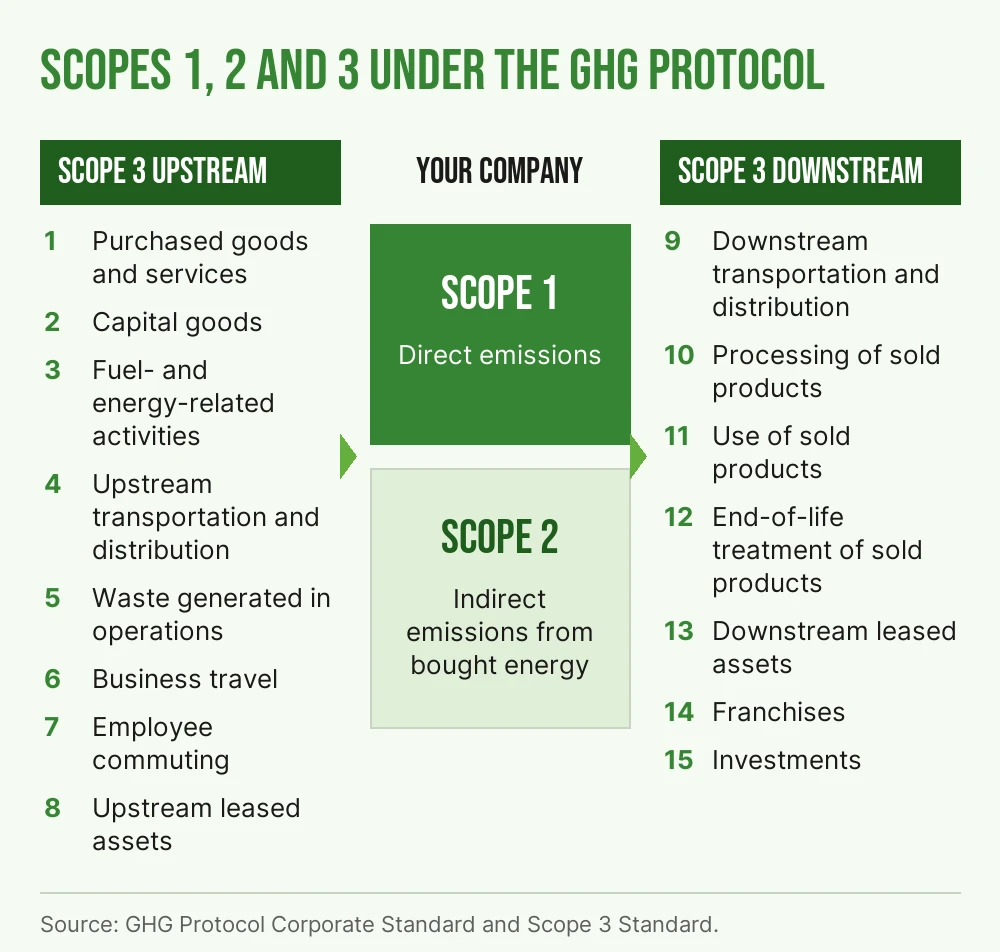
 E1-8 is the former E1-6 of the 2023 version. You give the gross emissions of your corporate carbon footprint, calculated under the GHG Protocol for the reporting period, in tonnes of CO₂ equivalent:
- Scope 1: with the percentage of emissions covered by the EU Emissions Trading System (EU ETS);
- Scope 2: with two methods, location-based and market-based;
- Scope 3: in total and for each significant category;
- direct biogenic CO₂ emissions: from burning or breaking down biomass, separately from Scope 1.
Here are the five most important rules for a corporate carbon footprint in line with ESRS E1-8:
- standard: the GHG Protocol;
- organisational boundary: financial control by default, or equity share or operational control as an option;
- gases and GWP: the seven Kyoto Protocol gases and the latest 100-year GWP values from IPCC reports;
- no offsetting: you do not deduct removals, carbon credits or emission allowances from the reported emissions;
- Scope 3: you update the significant categories every year and do a full inventory at least every three years.
You cannot limit emissions to part of your business. ESRS 1 lets you report a metric for only part of your operations or value chain when full data would cost too much. But this relief does not cover E1-8.
We describe how to choose the significant Scope 3 categories in the article on Scope 3 screening.
ESRS E1-9: greenhouse gas removal and mitigation projects
 The full name of the requirement is “Greenhouse gas removal and mitigation projects financed through carbon credits”. If your company runs projects that remove and store greenhouse gases in its own operations or value chain, it discloses:
- project description: both nature-based and technological solutions;
- quantity: the gases removed and stored in each project;
- risk of reversal: the assumptions, and how you monitor leaks and unintended releases;
- releases: unintended releases in the reporting period, deducted from the amount removed.
You can count removals under the EU framework for certified carbon removals (CRCF, Regulation (EU) 2024/3012). If your company buys carbon credits from projects outside its value chain, it reports:
- cancelled credits: credits verified under recognised standards and cancelled in the year. This means retired from the registry for good, so that nobody can use them again;
- credits bought but not cancelled: in tonnes of CO₂ equivalent;
- share of removals: the percentage of credits from removal projects, split into nature-based and technological sinks.
Some companies claim in public to be carbon neutral thanks to carbon credits. They must explain whether this weakens their reduction targets and how they judge the quality of the credits. We describe the credit market and prices in the article on carbon credits.
ESRS E1-10: internal carbon pricing
 An internal carbon price is an amount per tonne of CO₂e that you add to costs in your own sums, although nobody charges it. It shows the cost of emissions in decisions today, even where nobody pays for emissions yet. The two most common forms are:
- shadow price: you add it only in calculations, for example when you compare investments; no money moves;
- internal carbon fee: departments or group companies pay for each tonne of their emissions, and the money usually funds emission reduction projects.
Take a price of €100 per tonne. A gas boiler that emits 400 t CO₂e a year then gets an extra cost of €40,000 a year in the calculation. A heat pump, which costs more to buy, may then come out better over its whole life.
E1-10 shows whether such a price plays a role in decisions meant to cut emissions, and what role. You disclose two items:
- use: whether and in which decisions you use an internal carbon price. Examples are investment choices, transfer pricing between group companies and the scenario analysis from E1-2;
- average price: the average price per tonne for each system, for example one for the shadow price and another for the internal fee.
You must also explain whether the internal carbon price is consistent with the price used in impairment tests in the financial statements. Such a test checks, for example, whether a coal-fired plant is still worth its book value. After all, you will have to pay for its emissions in the future. If your climate strategy assumes €150 per tonne and the financial statements assume €60, you must explain the difference.
The ESRS do not require an internal carbon price. You report E1-10 only when it is material (ESRS 1 para. 24). Sometimes you do not use an internal price, but the information is material, for example with plants under the EU ETS. Then it is enough to say that you do not use one. In all other cases, you leave E1-10 out.
Compared with the 2023 version, the requirement is shorter. You no longer give the type of system, its scope, the source of the price or the emissions it covers. The link to the financial statements is also narrower. Before, it also covered the life and end value of assets and the value of assets bought in a takeover. Now, it covers only impairment tests. EFRAG said that few companies reported these data. It also brought the rule in line with IFRS S2.
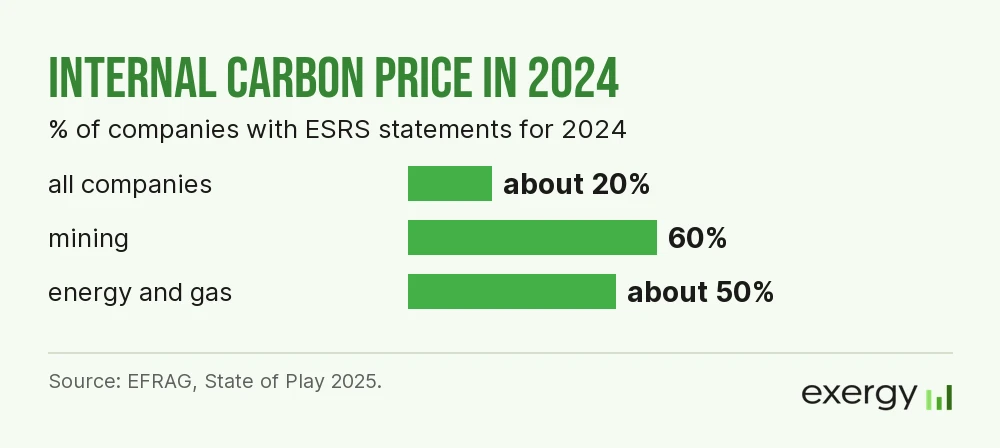
According to EFRAG, about 20% of the 656 companies that published ESRS statements for 2024 used an internal carbon price. In mining it was 60% of companies, and in energy and gas about 50%.
TotalEnergies adds at least $100 per tonne of Scope 1 and 2 emissions to its investment criteria. Where a country sets a higher price, it uses that one. After 2031, the price rises by 2% a year. The company uses the same price in impairment tests. Microsoft has charged its departments an internal carbon fee since 2012. In 2022, it announced a higher fee for business travel, $100 per tonne of CO₂e, to buy sustainable aviation fuel with the money.
ESRS E1-11: anticipated financial effects of climate risks and opportunities
 E1-11 adds information on financial effects. For material physical risks, your company discloses:
- assets at risk: the book value before adaptation actions, with a time horizon;
- assets covered by adaptation: the percentage of this value covered by adaptation actions;
- revenue: net revenue from activities exposed to material physical risk.
For material transition risks, it reports:
- assets at risk: the book value and the range of potential stranded assets in a 1.5°C scenario;
- assets covered by actions: the percentage of this value covered by mitigation actions;
- real estate used as loan collateral: split by energy efficiency class;
- liabilities: potential liabilities linked to the transition that are not yet in the financial statements;
- revenue: from activities exposed to transition risk, and from customers in the coal, oil and gas sectors.
You describe the method, assumptions and limits. You also give the value of assets or revenue linked to climate opportunities. You may give the amounts as a range. You may leave out most of these data in the first years, except the value of assets at risk and the part covered by actions. The risks you value come from the analysis in E1-2.
We describe an example of such an analysis in the article TCFD in practice.
What does ESRS E1 mean for suppliers of large companies?
 Emissions in E1-8 are the only ESRS topic metric that covers the value chain. All other metrics cover only your own operations. A company that reports under the ESRS calculates Scope 3, so it asks its suppliers for data. The Omnibus I Directive limits these requests:
- protected company: a company in the value chain that had up to 1,000 employees on average in the previous financial year;
- right to refuse: it may refuse information that goes beyond the voluntary standard (Delegated Regulation (EU) 2026/1560).
In its climate part, the voluntary standard covers:
- energy use: in MWh, split into renewable and non-renewable where possible;
- Scope 1 and 2 emissions: estimated, in tonnes of CO₂ equivalent, with Scope 2 location-based;
- reduction targets: if the company has set them, in absolute values for Scopes 1 and 2.
A supplier reports Scope 3 in it only if it finds Scope 3 relevant for its sector. Our checklist with a model email lists the data worth asking your own suppliers for.
Do you need data for ESRS E1?
We can help you prepare all 11 chapters of ESRS E1 for your company. Our team prepared one in four validated SBTi submissions from Poland. And 9 out of 10 companies for which we prepare a CDP submission have at least a B score.