

The new EU Construction Products Regulation has applied since 8 January 2026, but manufacturers still issue declarations under the old standards. From 2028, developers of new buildings over 1,000 m² must report the carbon footprint of the building (EPBD, 2024). They will ask manufacturers for the data. Under the European Commission work plan (2025), only 7 of 36 product families will get new mandatory standards by the end of 2029. Cement comes first.
- Construction Products Regulation: applies from 8 January 2026, but covers your product one year after its new standard becomes mandatory.
- Declaration of performance and conformity: replaces today's declaration of performance and also shows the carbon footprint (GWP).
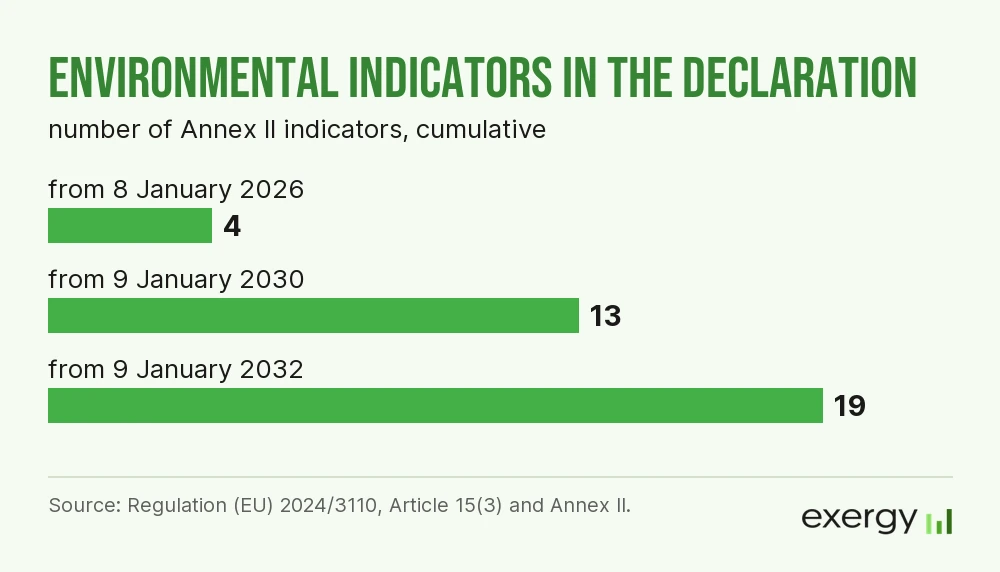
- Environmental indicators: four climate indicators at first, 13 from 2030 and all 19 from 2032.
- Digital Product Passport: required 18 months after a Commission act that does not exist yet.
- Penalties: each EU country sets its own, and they apply from 8 January 2027.
What is the new Construction Products Regulation?
 The new Construction Products Regulation is Regulation (EU) 2024/3110 of 27 November 2024. People often call it the new CPR or CPR2. It sets the same rules in the whole EU for selling construction products. It replaces the old CPR, Regulation (EU) No 305/2011. Under the old CPR, manufacturers have used the CE marking and issued declarations of performance (DoPs) since 2013. The new regulation was published in the Official Journal of the EU on 18 December 2024.
The aim stays the same. Construction products are described in the same way in every EU country, so buyers can compare products from different countries. You declare the same properties, called essential characteristics, for example load-bearing capacity or reaction to fire. They come from the basic requirements for construction works, such as structural safety and fire safety.
Three dates matter for manufacturers:
- 7 January 2025: the regulation entered into force, but only the rules that let the Commission start work on standards applied.
- 8 January 2026: most rules started to apply; the old CPR still works only for products with old standards.
- 8 January 2040: the last rules of the old CPR expire.
Some sources give 7 January 2025 as the start of the new duties. This is wrong. Manufacturers' duties started on 8 January 2026, and not for all products at once.
The new CPR divides products into 36 families. A family is a group of similar products, for example cement, windows and doors, or cables. The rules apply not only to you as a manufacturer, but also to importers, distributors and online marketplaces. Online sales to customers in the EU follow the same rules as sales through a wholesaler. The CPR also covers used products, for example elements from demolition that are ready for reuse, if the standard for their family allows it. Their CE marking shows the year of dismantling. Each EU country sets the penalties for breaking the rules, and these penalties apply from 8 January 2027.
When does the new CPR apply to construction product manufacturers?
 The new CPR does not cover all products from one day. Each product family moves to the new rules separately, when it gets a new harmonised standard. This is a European standard that you use to test the product and declare its properties. From the day the Commission makes this standard binding, you have one year to adapt, unless the Commission gives more time. After that, you issue the new declaration and meet the other duties of the CPR. You can also move to the new rules earlier, as soon as the standard applies.
If there is no standard, the Commission can decide itself which properties to test and how. This can happen, for example, if the European Committee for Standardization (CEN) does not prepare the standard within three years. The year to adapt then counts from the Commission's decision.
Until then, you place the product on the market as before, with a DoP under the old standard. The Commission will withdraw the old standard within one year from the day the family moved to the new rules. Products with a European Technical Assessment (ETA) have their own deadlines. You can get a new assessment under the old rules until 9 January 2031. You can place products on the market based on it until 9 January 2036.
The Commission set the order in its work plan for 2026–2029, published in December 2025. The dates in the plan are indicative. Work started with precast concrete products and structural metal products. But these two families will get new standards still under the old CPR. So cement should be the first family under the new rules:
| Product family (number in Annex VII) | Standard mandatory under the plan | New duties for manufacturers, at the earliest |
|---|---|---|
| Cement, building limes and other hydraulic binders (15) | Q4 2027 | Q4 2028 |
| Chimneys, flues and specific products, except free-standing chimneys (6) | 2028 | 2029 |
| Doors, windows, shutters, gates and related building hardware (2) | 2029 | 2030 |
| Reinforcing and prestressing steel for concrete (16) | 2029 | 2030 |
| Thermal insulation products, composite insulating kits and systems (4) | 2029 | 2030 |
| Flat glass, profiled glass and glass block products (30) | 2029 | 2030 |
| Structural timber products and elements (13) | 2029 | 2030 |
The plan gives no dates yet for the other 29 families. The Commission will update it by the end of 2028.
What changes in the declaration of performance?
 When your product family moves to the new rules, you issue a declaration of performance and conformity (DoPC). It replaces the DoP. Annex V gives its template. The DoPC still states the performance of the product. It also confirms that the product meets the rules for its family. You are responsible for both parts.
You face four changes:
- Product requirements: the Commission can set rules for a family, for example on safety or the environment. The DoPC confirms that the product meets them.
- Environmental data: the DoPC shows the impact of the product on the environment over its whole life cycle, including packaging.
- Electronic version: you send the DoPC in digital form, for example by email, or publish it on your website as a locked file. A product-type code links it to the product.
- More product information: the product comes with instructions for use, safety information and general product information. They must be in the language of the country of sale.
Environmental rules can cover the whole life of the product. This includes what happens after demolition, that is, the place of the product in the circular economy. The CPR lets the Commission require, for example:
- durability: a set service life of the product;
- secondary raw materials: the highest possible share of reused materials, recycled materials and by-products;
- reparability: easy repair and access to spare parts;
- recovery: options to reuse the product, recycle it and separate its materials at demolition;
- less packaging and waste, especially hazardous waste.
The DoPC is based on technical documentation. It shows what the product is for, the test and calculation results, and how factory production control works.
How do you declare the carbon footprint (GWP) of a product?
 The new CPR lists 19 environmental indicators. You calculate them in a life cycle assessment (LCA) of the product. The DoPC must include at least:
- from 8 January 2026: four climate change indicators. These are the total carbon footprint and its parts from fossil fuels, biogenic carbon (for example wood) and land use change;
- from 9 January 2030: nine more, among them ozone depletion, acidification, eutrophication, use of resources and water use;
- from 9 January 2032: the last six, among them particulate matter, toxicity for people and the environment, and land use.
These dates are not a deadline for you. You state the indicators only when your product family moves to the new rules. For example, cement should move at the end of 2028 at the earliest. So cement manufacturers will first state four climate indicators, and 13 from 2030.
Environmental Product Declarations (EPDs) under EN 15804+A2 use the same 19 indicators today. If you have a current EPD, you already have the data and the calculation model. But you cannot copy the results straight into the DoPC, because the new CPR changes three things:
- Calculation tool: you calculate the results in the free Commission software, always in the latest version. A new version becomes mandatory one year after it is published.
- Calculation rules: each product family will get its own rules (c-PCR). They may differ from the rules of your EPD programme.
- Generic (background) data: if you have no data of your own, you must use the European databases of the Commission. Plants in the EU Emissions Trading System (EU ETS) will sometimes be able to use data from that system.
The European databases will be cautious. They will tend to overstate the result, so that nobody picks data that suits them. So your own plant data on energy, raw materials and transport usually gives a lower and more realistic result.
A notified body checks the results under the new system 3+. You calculate the indicators yourself. The body checks the data, the assumptions and the calculations, and then issues a validation report. The assessment and verification systems from the old CPR (1+, 1, 2+, 3 and 4) stay.
The Commission can also require environmental labels on products that consumers buy. It has announced the first one for cement. The label will show the carbon footprint of cement when the new cement standards become mandatory.
Your customers will use the data from your DoPC. From 1 January 2028, every new building over 1,000 m² must have its life-cycle carbon footprint in its energy performance certificate. From 2030, this applies to all new buildings (Directive (EU) 2024/1275). A designer who calculates the carbon footprint of a building will take the data from the DoPCs of the chosen products.
We prepare an LCA and an EPD under EN 15804+A2 with data from your plant. We adjust the calculation model when the Commission publishes the rules for your product family.
Environmental Product Declaration (EPD) →What does the Digital Product Passport mean for manufacturers?
 Every product that moves to the new CPR will get a Digital Product Passport. The Commission will set the details in a separate act. Six months after this act enters into force, the passport system must work. After 18 months, you must use it. Before that, you can use it if you wish.
The passport is a set of data about the product. A code next to the CE marking, for example a QR code, leads to it. The passport will contain the DoPC. It will also give information on materials, safe use, repair, reuse and recycling. If the DoPC is in the passport, you do not have to supply it separately.
The Commission has not adopted this act yet (November 2026), so the duty will not start before 2028. Our page on the Digital Product Passport (DPP) explains how to prepare the data.
How will the new CPR affect public procurement?
 The Commission will set minimum environmental rules for construction products in public tenders. In tenders above the EU thresholds, public buyers will have to use them when they set environmental rules for products. They can also ask for more.
These rules can take one of four forms:
- Technical specifications: as part of the description of the product.
- Selection criteria: as conditions that bidders must meet.
- Contract performance clauses: as conditions for carrying out the contract.
- Award criteria: as points for better environmental performance.
A public buyer can skip these rules, for example if a product that meets them would raise the cost by more than 10%. But the buyer must check this first in a market consultation. The Commission will complete the first impact assessment by the end of 2026.
Public buyers can already give points for lower emissions. EU procurement law lets them include the cost of greenhouse gas emissions in life-cycle costing (Directive 2014/24/EU, Article 68).
How to prepare for the new CPR?
 The order of work depends on the deadline for your product family. It usually looks like this:
- Check your deadline: find your product family in Annex VII and in the Commission work plan.
- Collect plant data: energy, raw materials, packaging and transport for the last full year, separately for each product type.
- Calculate the carbon footprint and prepare an EPD: under EN 15804+A2, so you can later adjust the model to the rules for your family.
- Organise product codes: give each product type a unique code and prepare the data for the passport.
- Talk to your notified body: ask whether it will check environmental data under system 3+.
Our guide to calculating a product carbon footprint shows how the calculation works. You can see examples of declarations we prepared for manufacturers in our published EPDs.
Frequently asked questions about the new CPR
Must you state the carbon footprint in the declaration from 8 January 2026?+
No. You will state the carbon footprint one year after the Commission makes the new standard for your product family mandatory. Until then, you issue a declaration of performance under the old standard.
Do current declarations of performance stop being valid?+
Not at once. Old standards apply until the Commission withdraws them. It will do so within one year from the day your product family moved to the new rules. From then on, the product needs a declaration of performance and conformity.
Will an EPD replace the declaration of performance and conformity?+
No. An EPD under ISO 14025 and EN 15804 is voluntary. The declaration of performance and conformity is mandatory for a product with a harmonised standard. But the data and calculations from your EPD will help with the environmental part of the declaration.
Does the new CPR apply to distributors and online shops?+
Yes. Before selling, a distributor checks that the product has the CE marking and a declaration. An online offer must show the CE marking, the manufacturer's details and the passport code, where required. Online marketplaces must remove offers when a market surveillance authority tells them to. These duties also start only when the product family moves to the new rules.
Who will check the carbon footprint in the declaration?+
A notified body, under the new system 3+. You calculate the indicators yourself. The body checks the data, the assumptions, the calculations and whether you followed the rules. Then it issues a validation report.