
A large customer sends you a supplier survey or a tender form. One question asks for the carbon footprint of your product. Many companies then start to search. At best, they have the footprint of the whole company. That is a different number: it comes from different data and follows different rules.
- How to calculate a product carbon footprint: in seven steps, from the goal and the declared unit to the report and verification.
- Boundaries: between companies, the usual scope is cradle to gate.
- Data: measurements and invoices from your plant, footprints from suppliers, and database factors for the rest.
- Verification: ISO 14067 does not require it, but customers, EPDs and PACT usually do.
What is a product carbon footprint?
A product carbon footprint (PCF) is the greenhouse gas emissions of a product's life cycle, for one unit of the product. The unit can be one kilogram, one piece or one square metre. You calculate it with life cycle assessment (LCA), but only for one impact category: climate change. The result is shown in carbon dioxide equivalent (CO₂e).
A corporate carbon footprint looks at things from a different angle. For a company, you add up all its emissions for one year. You show them in three scopes: direct, indirect from energy and from the value chain. A product carbon footprint follows the supply chain of one product. It starts with the extraction of raw materials and their transport. Then it covers production and, if needed, the later stages: use and end of life. The data sources are similar, but you use them in a different way and with different emission factors.
This diagram shows the difference:
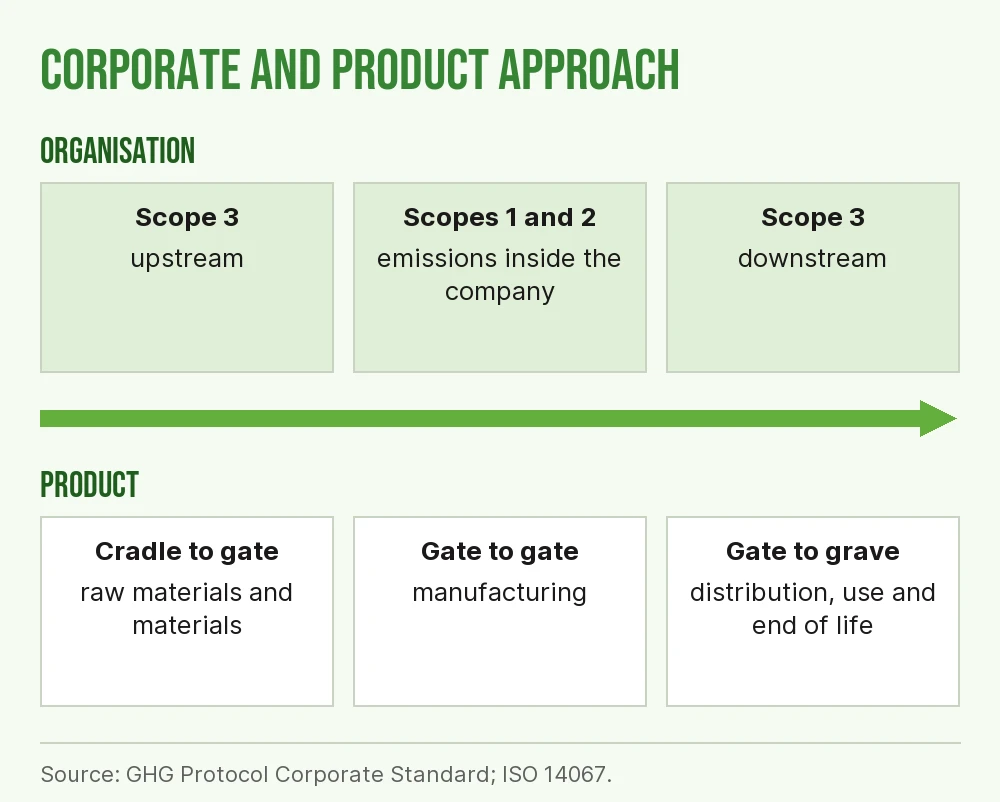
We explain the difference in more detail in the article how a company's carbon footprint differs from a product's. In practice, the two calculations meet. Product footprints from suppliers are the most accurate way to calculate category 1 in Scope 3.
How is a product carbon footprint different from LCA and an EPD?
 In talks with customers, these three terms often appear together, and people sometimes mix them up. They are linked, but they are not the same:
- PCF: the product carbon footprint covers one impact category, climate change. The result is in kilograms of CO₂e per unit of product.
- LCA: life cycle assessment covers more impact categories. Next to climate, it looks at the use of resources and water, acidification, eutrophication and others.
- EPD: an Environmental Product Declaration is a formal document that follows the rules of a programme and product category rules. It is based on LCA, and an independent third party must verify it.
A carbon footprint can be a report on its own, part of a wider life cycle assessment or the first step to an EPD. The type of study depends on the goal. A purchasing or ESG team asks for a carbon footprint. A construction tender asks for an EPD. A customer from the chemical or cosmetics industry may ask for a full LCA. Read who publishes and verifies EPDs in our article on EPD programme operators.
Why does your customer need the carbon footprint of your product?
 Customers rarely ask out of curiosity. A large company needs this number for its own duties:
- Reporting: supplier data is the most accurate way to calculate purchased goods in Scope 3. These emissions then go into the sustainability report under the Corporate Sustainability Reporting Directive (CSRD).
- Purchasing: if price and quality are similar, the offer with the lower footprint wins. It lowers the buyer's result without any investment on the buyer's side.
- Reducing emissions: without product data, the buyer cannot see if it makes sense to change a raw material, an energy supplier or the packaging.
For you as a supplier, the same number works both ways. It shows where reducing the carbon footprint costs least. And it becomes a sales argument for the purchasing and ESG teams that ask for it.
What is the formula for a product carbon footprint?
 The formula is simple. The hard part is collecting the data and choosing the right emission factors.
Product carbon footprint = Σ (activity data × emission factor) ÷ number of product units
Here is a simple example for a batch of 10,000 steel products. The scope is cradle to gate, and the emission factors are examples only:
- steel: 8,000 kg × 2.1 kg CO₂e/kg = 16,800 kg CO₂e;
- electricity: 50,000 kWh × 0.55 kg CO₂e/kWh = 27,500 kg CO₂e;
- natural gas: 12,000 m³ × 2.0 kg CO₂e/m³ = 24,000 kg CO₂e;
- transport of raw materials: 1,500 tonne-kilometres × 0.11 kg CO₂e/tkm = 165 kg CO₂e.
The total is 68,465 kg CO₂e, so 6.85 kg CO₂e per piece. The emission factor for electricity is often the largest single item. So your choice of this factor can decide the size of the whole product footprint.
Which boundaries should you use for a product carbon footprint?
Boundaries show which stages of the product life cycle your result includes. These three options are the most common:
- Gate to gate: only the processes in your plant. This is the easiest to calculate, but it is the least useful for your customers.
- Cradle to gate: raw materials, their transport and production, until the product is ready to leave your plant. This is the standard between companies and the basis for declarations to customers.
- Cradle to grave: the full life cycle, with distribution, use and disposal. You need it for messages to consumers, for ecodesign and for EPDs.
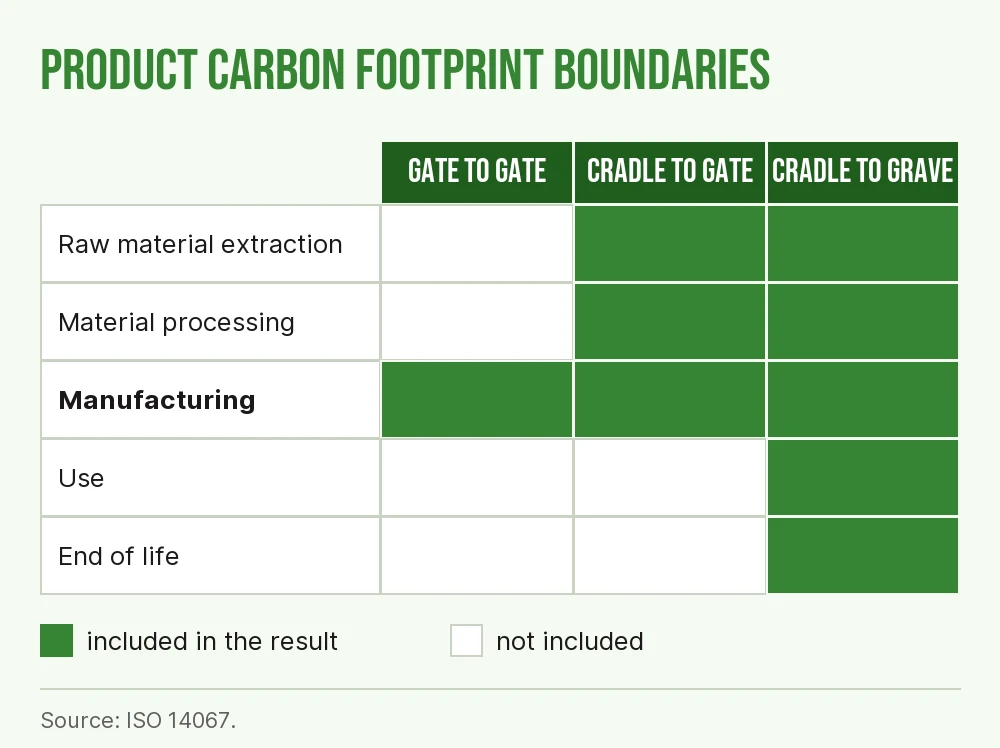
State the boundaries with every result. The same product has two very different results for cradle to gate and cradle to grave. It makes no sense to compare them.
Which standards describe a product carbon footprint?
 The calculation and the data collection look similar in every standard. The differences are in the details:
- how to split emissions between products,
- what you may leave out,
- what the report must include,
- if someone independent must check the result.
| Standard | Purpose | When to choose it? |
|---|---|---|
| ISO 14067 | Standard for the carbon footprint of products, based on ISO 14040 and ISO 14044 | The default choice for a declaration to a customer |
| GHG Protocol Product Standard | Rules for calculating emissions in the product life cycle | When your customer reports Scope 3 under the GHG Protocol |
| EN 15804 and ISO 14025 | Rules for EPDs of construction products, in modules A1 to D | Construction and tenders that require an EPD |
| PEF | The EU Product Environmental Footprint method, which covers more environmental impacts than the carbon footprint | Projects for EU rules and assessments with many criteria |
| PACT Methodology | Common rules for calculating and sharing product footprints in the supply chain | When your customer asks for a footprint “in line with PACT” |
We explain where EPDs stand among other labels in the article on type I, II and III environmental labels and declarations.
How to calculate a product carbon footprint step by step?
 The calculation has seven steps:
- Set the goal and the declared unit: before you start, decide why you need the result. Is it for a customer, a tender or your own analysis? And does it refer to one piece, one kilogram, one metre or one litre?
- Set the boundaries and the data period: the standard between companies is cradle to gate. Use data from a full calendar year, so that seasonal changes in production even out.
- Draw a process map: show all inputs and outputs, from raw materials and packaging, through energy and internal transport, to the waste from each stage.
- Collect the data: energy and fuel use from meters or invoices, stock records, waste records and transport distances.
- Choose emission factors: start with public LCA databases or industry factors. For the inputs that matter most, ask your suppliers for their own factors.
- Split emissions between products: if your plant makes several products, you need allocation, which we describe below.
- Calculate, describe and verify: show the result per unit and write a report on the method and data. For a declaration to a customer, add verification.
What data do you need to calculate a product carbon footprint?
 The list of data is the same in most projects. Most companies can collect it from documents that their accounting and production teams already have:
- invoices for electricity, for heating and process fuels, and for heat;
- records of refrigerants and refills;
- amounts of raw materials, packaging and auxiliary materials;
- records of production waste and how it is treated;
- logistics data for raw materials: distances, means of transport, load weights;
- a list of company vehicles with mileage or fuel use;
- production volume in the same period, in the unit of your result.
Supplier data is a separate matter: the carbon footprint of what you buy from them. If you buy the same raw material from several suppliers, ask each of them, because their emissions can differ. Do not ask for “the carbon footprint” in general. Ask for the details that decide if the number is useful:
- Method: which standard the supplier used, for example ISO 14067 or the GHG Protocol.
- Data period: which year the input data comes from.
- Boundaries: what the result covers, usually cradle to gate.
- Verification: if an independent party checked the number, and who.
- Unit: kilograms of CO₂e per kilogram, per piece or per tonne-kilometre, linked to the invoice.
A checklist of questions for suppliers and an email template to ask for the carbon footprint of the raw materials you buy.
Download free →How to split emissions between products? Allocation rules
 A plant rarely makes only one product. So you must split the emissions from boilers, compressors or lighting. The allocation method can change the result a lot. This example shows how much the choice matters:
| Allocation method | Unit | Product A | Product B | Emissions of product A |
|---|---|---|---|---|
| Physical | mass | 9,000 kg | 1,000 kg | 90 t CO₂e (90%) |
| Physical | number of pieces | 500 pcs | 500 pcs | 50 t CO₂e (50%) |
| Economic | revenue | EUR 0.5 million | EUR 2 million | 20 t CO₂e (20%) |
The standards give an order of methods. First, try to avoid allocation: divide the process into sub-processes for each product. Only then choose a key to split the emissions. Describe the method and the reason for it in the report, because it has a strong effect on the result. Sometimes industry rules tell you which method to use.
Do you need a separate footprint for each product?
 The calculation and the report can cover a group of products. But only if the differences between them do not change the result much. You can calculate one footprint for a group of products if they:
- have a very similar material composition;
- are made in the same process and at the same site;
- differ only in features that do not affect emissions, for example colour or finish.
Describe the limits of the group in the method. If one group mixes products with a different density, material or production technology, the result is distorted. Then it does not describe any of them reliably.
Which errors happen most often when you calculate a carbon footprint?
 We see five errors again and again, in every industry:
- Treating the product footprint as Scope 3: Scope 3 does not replace a product study, even if it gives you most of the data.
- No clear boundaries: the same number means one thing for production only and another for the full life cycle.
- Random emission factors: two factors for a similar material may come from different regions and technologies.
- Assumptions without a record: an assumption is not an error, but leaving it out of the report is.
- Using the result for another goal: an internal analysis is not fit for a tender or an EPD without checks and verification.
When are your own calculations enough?
 Not every calculation needs a consultant or a verifier at once. Your own first calculation makes sense when you want to:
- understand how the process works,
- see where data is missing,
- prepare data before a talk with a customer or an adviser,
- check which parts of the product weigh most in the result,
- compare two technical options for an internal decision,
- build awareness in production, purchasing and quality.
This first step takes you from “where do we start?” to a clear list of data and gaps. For internal use, this is usually enough.
Things change when the number leaves your company. Examples are a declaration for a customer, an entry in a tender, a claim on a label or data for a customer's report. They all need a described method, clear boundaries and data that someone can check. Then you usually add a product carbon footprint verification, because the customer will often ask for it anyway.
What should a product carbon footprint report include?
 The final report must let the reader repeat the result and judge what it can be used for. A reliable report includes at least:
- the name and description of the product or product group, and the declared unit,
- the system boundaries,
- the period of the data,
- the production site,
- the input data with the sources of the emission factors,
- the assumptions and the allocation method,
- the share of each stage in the result, which shows where to reduce,
- the limits of the study and the allowed uses of the result.
What to do when a customer asks for a footprint in line with PACT?
 PACT (Partnership for Carbon Transparency) is an initiative of the World Business Council for Sustainable Development (WBCSD). It sets common rules for calculating and sharing product footprints in the supply chain. It is not a standard or a certificate. It is a free method built on the GHG Protocol and ISO 14067. The current version is version 3, published on 30 April 2025. For a supplier, it means four requirements:
- Cradle to gate, with transport to the customer calculated and shown separately.
- Share of primary data: you must state which part of the result comes from your own measurements. From the end of 2027, you must also rate the data quality.
- Verification of the calculation model by an independent party, with limited assurance.
- Full data set when you share the result: declared unit, period, boundaries, standards used, and the result with and without biogenic removals.
PACT limits the validity of a result to three years. If your process changes by more than 10%, you must calculate again. A good calculation under ISO 14067 meets most of these requirements. So you usually only need to add documents, not calculate everything again.
Do you need to verify a product carbon footprint?
 ISO 14067 does not require verification. So you can publish a result that nobody checked. In practice, the reader of your declaration decides:
- Business customer: more and more customers ask if an external body checked the calculation.
- EPD: third-party verification is mandatory, and there is no EPD without it.
- PACT: it requires independent verification of the calculation model.
- Marketing: under the Empowering Consumers Directive, which applies in the EU from 27 September 2026, you must prove a claim about lower emissions. Verification is the simplest proof.
We explain how verification differs from validation and assurance in a separate article on verification, validation and assurance. To have your result checked, order a product carbon footprint verification.
How long is a product carbon footprint valid?
 In practice, a product carbon footprint report is valid for 3 to 5 years. This differs from case to case. Some customers ask for an update every year or every two years. You usually calculate again after a change of technology, of the supplier of a main raw material or of the energy source. The PACT method limits validity to three years and asks for a new calculation if the process changes by more than 10%.
Do you need a product carbon footprint that your customer accepts without questions?
We calculate product carbon footprints under the GHG Protocol and ISO 14067. You get a process map, a report and a declaration for your customer in two languages. If you already have a calculation, we can check it in a product carbon footprint verification.