
In 2022, 4,100 of the 18,600 companies that reported to CDP said they had a climate transition plan in line with 1.5°C. Only 81 of them gave enough detail on all 21 indicators of a credible plan (CDP, 2023). Your customer, your bank or your auditor will not accept a target on its own. They want to see the steps, the costs and the results for each year.
- How to reduce your business carbon footprint: follow seven steps, from calculating emissions to monitoring progress every year.
- Starting point: a calculated footprint in Scopes 1, 2 and 3 and a chosen base year.
- Target: ambitious but realistic, set with the SMART method or with SBTi criteria.
- Scenarios: reduction actions with their costs and effects, from which you choose one plan.
Step 1: Calculate your carbon footprint in Scopes 1, 2 and 3
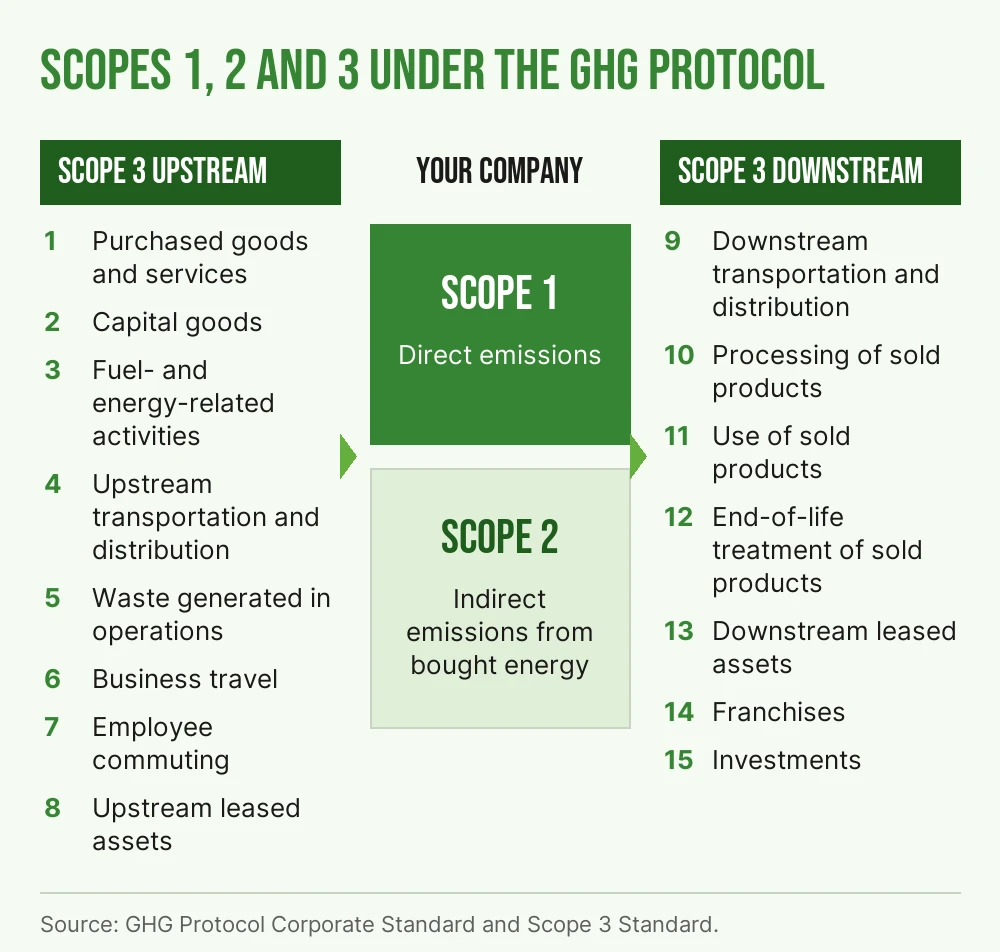
You calculate a company's carbon footprint in three scopes:
Scope 1 covers direct greenhouse gas emissions in your company. The sources are owned or controlled by your company. Most often, these are fuels burned by company vehicles, fuels burned for heating and refrigerants leaking from air conditioning.
Scope 2 covers indirect emissions from the electricity, heat or steam that your company uses. They are indirect because they happen outside your direct control, for example in a power plant. But your company needs this energy to work.
Scope 3 covers indirect emissions in your whole value chain. It has 15 categories in two groups.
Upstream emissions, which come into your company:
- Category 1: purchased goods and services
- Category 2: capital goods
- Category 3: fuel- and energy-related activities
- Category 4: upstream transportation and distribution
- Category 5: waste generated in operations
- Category 6: business travel
- Category 7: employee commuting
- Category 8: upstream leased assets
Downstream emissions, which leave your company:
- Category 9: downstream transportation and distribution
- Category 10: processing of sold products
- Category 11: use of sold products
- Category 12: end-of-life treatment of sold products
- Category 13: downstream leased assets
- Category 14: franchises
- Category 15: investments
Calculating Scope 3 can take a lot of work. Many factors and links in the value chain play a role. So carbon footprint reporting in Scope 3 can be complex. Read more in our article on Scope 3 emissions.
Step 2: Choose a base year and an intensity indicator
 To report results in a consistent way, your company needs a base year. The base year is the point from which you measure progress in reducing emissions. With the right base year, you can set realistic targets and track your progress.
The base year shows the trend of your emissions over time. You can see if your reduction actions work and if your company reduces its corporate carbon footprint. It also lets you compare your current emissions with the base year in a reliable way.
Three things matter when you choose a base year:
- You need verifiable data on Scope 1, 2 and 3 emissions for that year. Choose the most recent year with data.
- The base year should be typical for your company's emissions. Compare your emissions and your business activity over several years to check this.
- The base year should keep your target ambitious. The target should lead to net zero by 2050 at the latest. Plan a straight-line cut from the base year, in absolute emissions or in intensity.
To measure progress, you can also use an intensity indicator:
- emissions per unit of product: greenhouse gases per unit you produce. Factories use it often, because their production volume changes from year to year.
- emissions per unit of floor area: greenhouse gases per square metre. It matters in real estate, where most emissions come from heating, lighting and energy use.
- emissions per unit of revenue: greenhouse gases per euro of revenue. It shows your progress in relation to the size of your business.
- emissions per unit of transport: greenhouse gases per unit of goods moved or per kilometre driven. It shows the emissions of your logistics.
- emissions per unit of energy used: greenhouse gases per MWh. It suits companies that use a lot of energy, and it also shows your energy efficiency.
Step 3: Set an ambitious reduction target
 To set an ambitious target, look at what your company can do and what limits it has. The target should be ambitious but realistic. So adapt the plan to your company.
These four actions help you set the target:
- Understand the goals of the Paris Agreement. They are the reference point for any ambitious target.
- Analyse your current carbon footprint. It shows your main emission sources, where you will need reduction actions.
- Prepare an action plan. It lists the actions, the timetable, the expected costs and the expected benefits.
- Use the SBTi criteria. The Science Based Targets initiative (SBTi) gives criteria for targets based on climate science. They take into account global climate goals and the features of each company.
The SMART method helps you set a target that is ambitious, achievable and precise. SMART stands for five criteria:
- Specific: the target is clear, so that everyone understands what to do. For example, reduce greenhouse gas emissions by a set percentage or a set number of tonnes of CO₂e by a set year.
- Measurable: you can measure the target and monitor it. For example, with data on electricity, heating fuels or other indicators.
- Achievable: the target is ambitious, but your company can reach it with its resources and limits. Check the available technologies and your budget.
- Relevant: the target matters for your company and how it works. It links business goals with sustainability goals.
- Time-bound: the target has a deadline, so you can plan a timetable. When do you start? How often and how do you measure the effects? By when do you reach the target?
Step 4: Build reduction scenarios
 To reduce your carbon footprint, you need to analyse possible actions, their costs and their benefits. You know how to set a target. Now think about which actions your company can take.
These are possible reduction actions, with their expected costs and effects:
Renewable energy
Solar panels or wind turbines need a large investment at the start. Over time, the energy savings can pay back the cost. Your own installations also make you less dependent on suppliers and on energy prices.
Guarantees of origin
Guarantees of origin are certificates that show where electricity comes from. When you buy them, you can state that the electricity you use comes from renewable sources. This lowers your Scope 2 emissions under the market-based method. The price depends on the country, the technology and the volume.
A cleaner vehicle fleet
Newer and cleaner vehicles use less fuel and so emit less CO₂. Electric cars use about three times less final energy than cars with combustion engines.
Energy efficiency
New heating, modern equipment, better processes, new lighting or insulation need an investment at the start. In return, you get lower energy costs, lower bills for electricity and gas, and more efficient production.
A different energy source
You can switch from coal, oil or gas to heat pumps, renewable heat or renewable electricity.
Reduction actions should fit your company. They differ by industry and by location.
Small steps can also bring large effects. Your company may not be ready for big changes. Then start with these actions:
- new lighting: LED bulbs, motion sensors and lighting control lower your electricity use, your bills and your CO₂;
- less waste: produce less waste and support recycling and reuse of materials;
- hybrid or remote work: where possible, this cuts the emissions from commuting.
With these actions, a reduction target for your company can look like this:
“Reduce carbon dioxide emissions by 30% by 2030. Use renewable energy installations and guarantees of origin, and switch 20% of the company fleet to electric vehicles.”
This target meets all five criteria:
- specific: cut CO₂ by 30%;
- measurable: you can monitor CO₂ emissions;
- achievable: the actions fit your company;
- relevant: it fits your strategy;
- time-bound: by 2030.
Step 5: Choose the scenario to carry out
 To choose the best scenario, think about how well it reduces emissions and how it affects your operations. For each scenario you prepared, check its effect and its benefits.
Look closely at the investment costs and at the long-term savings. Decide what your company wants to achieve by reducing its carbon footprint. Is it sustainability, less risk from emissions rules, a better reputation or long-term savings?
Check how each scenario affects your operations. Choose the scenario that fits your strategy and goals best and that also reduces your carbon footprint.
Step 6: Have your target validated by SBTi (optional)
 External validation by the SBTi shows that your plan follows global climate goals.
SBTi validation confirms that your target is in line with science. The SBTi bases its criteria on current climate research and on the Paris Agreement. So validated targets match the global work to limit warming. The process also helps you reach your targets. It can help you understand your targets, find areas to improve and build a better plan.
SBTi validation is recognised worldwide. It shows that a credible and independent body has assessed your targets. So your stakeholders trust your targets more, and this improves your reputation.
Step 7: Monitor progress every year
 Finally, monitor your progress towards the reduction targets every year. Regular monitoring shows if your carbon footprint is going down as planned. Technology and rules change, so you may need to adjust your strategy.
Why should you reduce your carbon footprint?
 A carbon footprint is the total greenhouse gas emissions of a company, a product, a person or an event. People often link the term with carbon dioxide only. But it covers more gases: methane, nitrous oxide and fluorinated gases (SF₆, NF₃, HFCs and PFCs).
Companies often calculate their carbon footprint because of market requirements, CDP disclosure or sustainability reports.
There are four main reasons to reduce it:
- Regulation and ESG: EU rules such as the CSRD ask large companies for climate data, and these companies ask their suppliers for it.
- Climate change: forest fires, heatwaves, droughts and floods already happen. Greenhouse gas emissions cause global warming. If we reduce them, we can still slow these changes and limit the harm to people, ecosystems and the environment.
- Public health: diseases such as malaria or dengue were not a problem in Europe. A warmer climate lets the insects that carry them spread further. Changes in humidity, rain and snow also help different pathogens to develop.
- The environment: CO₂ emissions harm not only the climate, but also ecosystems on land and in the sea. Ocean acidification, changes in weather and loss of biodiversity often follow from carbon emissions.
The Paris Agreement and the carbon footprint
 Climate change is a global problem, so countries need to work together. In 2015, almost all countries in the world agreed to act together in the Paris Agreement.
The Paris Agreement is an international climate treaty. It aims to cut global greenhouse gas emissions and to help countries adapt to climate change. Its main long-term goal is to keep global warming well below 2°C above pre-industrial levels and to try to limit it to 1.5°C.
The agreement also aims for a balance between emissions and removals in the second half of this century. The EU set itself the goal of climate neutrality by 2050 in the European Climate Law. Meeting these goals lowers the risk of serious and irreversible effects of climate change.
Under the Paris Agreement, governments must present national plans to reduce emissions every 5 years. Each new plan must be more ambitious.
Many private companies also prepare their own plans to support the Paris goals and reduce their carbon footprint. The Science Based Targets initiative (SBTi) helps companies around the world set decarbonisation targets in line with good practice. Read more about a decarbonisation strategy in line with SBTi.
The Science Based Targets initiative helps companies set targets to cut greenhouse gas emissions and change how they do business. A company's target is “science-based” if it matches what the latest climate research says is needed to meet the goals of the Paris Agreement.
Are you looking for experts in carbon footprints and decarbonisation?
We calculate carbon footprints in Scopes 1, 2 and 3 and prepare reduction plans with costs and timetables. See our decarbonisation strategy service. For UK public tenders, we also prepare a Carbon Reduction Plan under PPN 006.