

The European Commission wants to double the share of recovered materials in the EU economy by 2030. Buildings and infrastructure take about half of all materials extracted in the EU (Circular Economy Action Plan, 2020). The EU's circular material use rate was 12.2% in 2024, one percentage point more than in 2015. In Poland, it fell from 11.9% to 7.7% over the same period (Eurostat, 2024). So new rules keep coming. The new Construction Products Regulation lets standards set a minimum recycled content. The Commission has also announced a Circular Economy Act for the end of 2026.
- Recycled building materials: no law sets a minimum recycled content yet, but EU rules ask for figures that depend on it.
- Carbon footprint: in metals, recycled content cuts it several times; in aggregate and gypsum, transport and drying cancel most of the gain.
- Price: cheaper secondary raw material often needs costlier processing, and recycled material in high demand can cost more than virgin.
- Quality: the requirements are the same; the risk comes from contamination and variable input.
- Gypsum and plasterboard: a board can take 20–30% recycled gypsum, but the gain is more in raw material than in carbon.
What is recycled content in building materials?
 Recycled material is material recovered from waste and processed so that it can replace a virgin raw material in a new product. In construction, the most common examples are aggregate from crushed concrete and brick rubble, and steel and aluminium scrap. Others are glass cullet, plastic regranulate and gypsum recovered from plasterboard.
Rubble is recycled most often. Clean concrete rubble, crushed on site or at a processing plant, becomes construction aggregate. In Poland, it goes mainly into roads, sub-bases and surfaces, and rarely back into concrete. Materials of higher value, such as steel and aluminium, go back into the same type of product many times.
When you declare recycled content, its origin matters. There are two basic types of recycled material:
- Pre-consumer recycled material: material recovered from a waste stream during production and used outside the process in which it arose.
- Post-consumer recycled material: material from products at the end of their use. Examples are demolition rubble, scrap from dismantling and boards removed during renovation.
Material that a plant recovers and returns to the same process does not count as recycled content. This covers offcuts and rejects that go back to the same line. It is normal raw material management. By-products of other industries form a separate group. Examples are gypsum from flue gas desulphurisation (FGD gypsum), fly ash and blast furnace slag. Formally, they are not waste or have lost waste status. Whether you may count them as recycled content depends on the system in which you make your declaration:
| Secondary raw material | Example in construction | Is it recycled content? |
|---|---|---|
| Post-consumer | aggregate from rubble, scrap from demolition, gypsum from boards removed during renovation | yes |
| Pre-consumer | production waste passed to another process or plant | yes, if it does not return to the process in which it arose |
| Returned to the same process | board offcuts and rejects that go back to the same line | no |
| By-product | FGD gypsum, fly ash, blast furnace slag | depends on the system; it is safer to state it separately |
Which rules apply to recycled content in construction?
 There is no general, mandatory minimum of recycled content for building products in the EU today. So far, the Commission has announced the first such requirement only for aluminium in selected building products. For now, the rules work indirectly. They force waste sorting on construction sites, which creates a supply of secondary raw material. They also ask producers and investors for figures that recycled content affects. The table shows the main laws that apply now:
| Law | What it changes | When |
|---|---|---|
| Regulation (EU) 2024/3110 (new CPR) | the declaration of performance will cover environmental properties, starting with the carbon footprint (GWP); standards may set a minimum recycled content | applies from 8 January 2026; for each product group after new standards are adopted |
| Directive 2008/98/EC (Waste Framework Directive) | a target of 70% recovery of construction waste, including backfilling; conditions for by-products and end-of-waste status | target from 2020 |
| Poland: Waste Act, Article 101a | producers of construction and demolition waste must sort wood, metals, glass, plastics, gypsum and mineral waste; fines from PLN 1,000 to PLN 1 million | from 1 January 2025 |
| EPBD, Directive (EU) 2024/1275 | the whole-life carbon footprint of a building, shown in its energy performance certificate | from 2028 for new buildings over 1,000 m², from 2030 for all new buildings |
| EU Taxonomy, Delegated Regulation 2023/2486 | a building that makes a substantial contribution to the circular economy limits virgin raw material in its three heaviest material groups. For example, the limit is 65% for gypsum and 30% for metals | in force |
| EmpCo, Directive (EU) 2024/825 | bans claims about a whole product when they concern only part of it, and vague claims without proof | EU countries from 27 September 2026; Poland from 27 September 2027 |
| Steel and Metals Action Plan, COM(2025) 125 | the Commission will prepare mandatory recycled aluminium content in relevant building products, within the Circular Economy Act | announced for Q4 2026 |
From a producer's point of view, three points matter most:
- Declaration of performance with GWP: the new CPR brings it in step by step, product family by product family. For gypsum products, the Commission's working plan foresees a standardisation request around 2028. So plasterboard will be declared under the old rules for a few more years.
- No data means virgin material: under the Taxonomy criteria, a product without information on recycled content counts as 100% virgin. An investor who aims for compliance will choose a supplier with a documented figure.
- Sorting on site: in Poland, construction waste has been sorted into at least six fractions on site since 2025. Gypsum from construction and demolition goes into a separate container. For the first time, this gives producers a real source of clean secondary raw material.
On top of this comes demand that no law sets: building certifications, tender criteria and the requirements of large investors. In public procurement, buyers can use environmental criteria and life-cycle costing. The basis is Articles 67 and 68 of Directive 2014/24/EU, and in Poland, Articles 242 and 245 of the Public Procurement Law. The new CPR also foresees mandatory minimum requirements for green public procurement, which the Commission has yet to adopt.
Do building certifications reward recycled content?
 In Poland, 2,829 buildings hold at least one multi-criteria certificate, with a total area of 57.6 million m² (PLGBC, 2026). The most popular systems reward recycled content, each by different rules:
| System | Reward for recycled content | Evidence |
|---|---|---|
| LEED v4.1 | a credit for sourcing raw materials. Recycled content counts by weight: post-consumer plus half of pre-consumer, times the product cost. 1 point at 20% of the cost of products in the building, 2 points at 40% | a producer document with a split into pre- and post-consumer under ISO 14021, or an EPD; without the split, all of it counts as pre-consumer |
| LEED v5 | recycled content scores only in finishing products (such as floors, walls, ceilings and insulation); the structure and envelope count through the carbon footprint | producer documents under ISO 14021; for the carbon footprint, a product EPD with external verification |
| BREEAM International | directly only for aggregate: 1 credit when at least 25% of aggregate in structural uses is recycled. Indirectly through the life cycle assessment and a separate credit for EPDs | delivery documents and supplier confirmation; EPDs under EN 15804 |
| DGNB | the share of secondary raw materials in the mass of materials; internal recycling at the producer does not count | a certificate from a recognised standard counts about three times more than a producer's self-declaration |
For a producer, the strongest evidence is a product EPD that states recycled content separately for pre- and post-consumer material.
How does recycled content affect the carbon footprint and other environmental indicators?
 In EPDs, post-consumer recycled material enters the calculation without the burden of its previous life. Only its transport and processing count, from the moment the waste stopped being waste. So recycled content cuts greenhouse gas emissions where making the virgin raw material is emission-intensive. It changes little where emissions arise only in the producer's own process. Tell apart two levels: the raw material itself and the finished product. In the product, the raw material is only one of the parts:
| Material | Virgin raw material | Recycled material | Share of the raw material in the product |
|---|---|---|---|
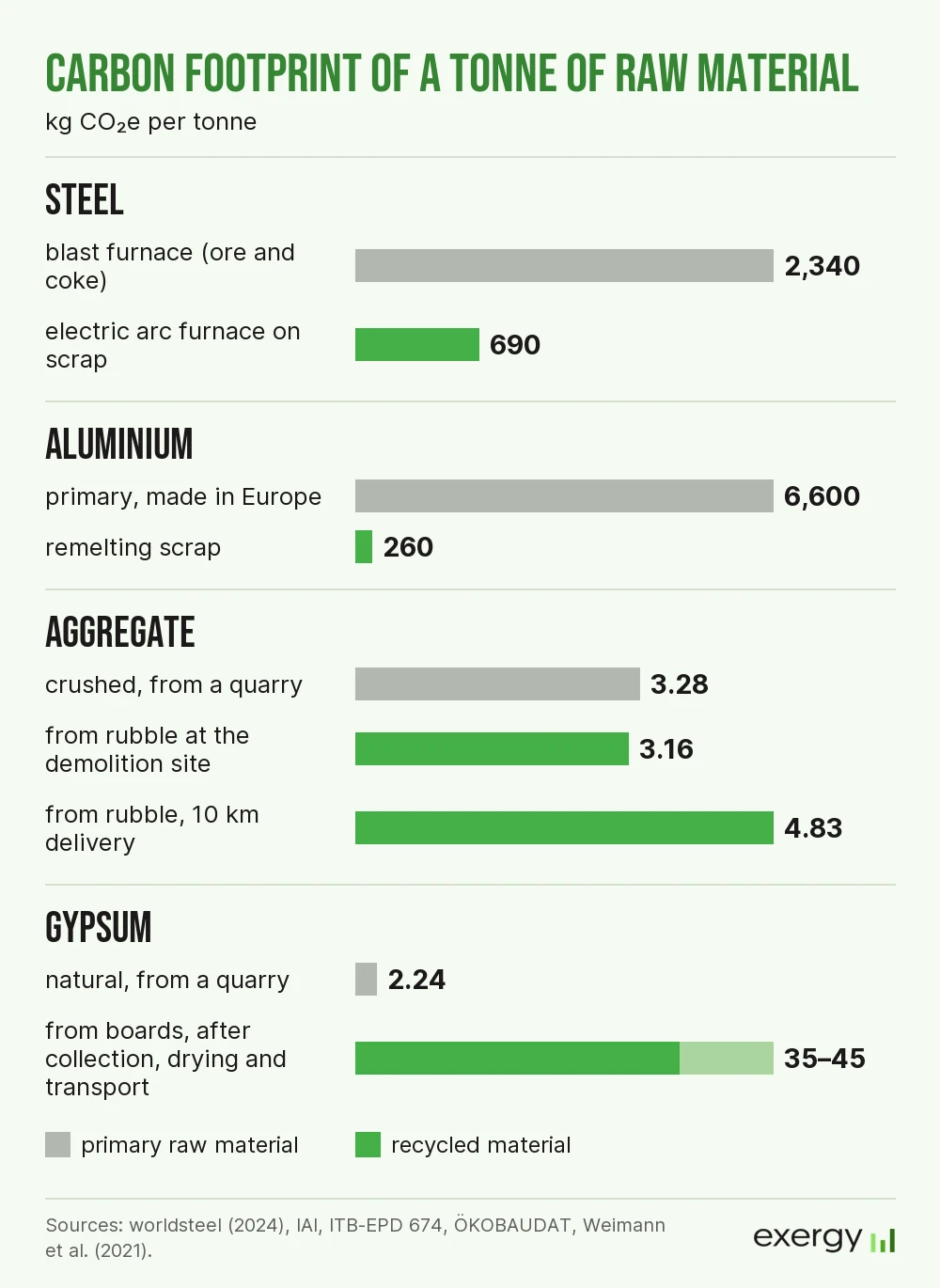
| Steel | blast furnace: 2.34 t CO₂ per tonne of crude steel | electric arc furnace on scrap: 0.69 t CO₂ | about 3.4 times less (worldsteel, data for 2024) |
| Aluminium | primary, made in Europe: 6.6 kg CO₂e/kg | remelting scrap only: 0.26 kg CO₂e/kg | recycling uses about 95% less energy (IAI) |
| Aggregate | crushed: 3.28 kg CO₂e/t (ITB-EPD 674) | from rubble processed at the demolition site: 3.16 kg CO₂e/t; with a 10 km delivery: 4.83 kg | aggregate is 1–5% of the footprint of concrete; cement gives 75–90% (Arup) |
| Gypsum | natural: 2.24 kg CO₂e/t (ÖKOBAUDAT) | from boards, after collection, drying and transport: about 35–45 kg CO₂e/t (Weimann et al.) | raw gypsum is about 9% of the footprint of a board; the rest comes mainly from processing (Morsali et al.) |
The percentage of recycled content and the carbon footprint are two different numbers. You can see this well in the EPDs of steel products that we prepared:
- Ferrostal Łabędy (Cognor), reinforcing bars and hot-rolled sections: the input is almost only scrap, 1,150 kg of secondary material per tonne of product. The footprint is 961 kg CO₂e per tonne in modules A1–A3. We have listed this and our other declarations on our page of published EPDs.
- Where the result comes from: 800 kg comes from melting in the electric arc furnace and rolling. Electricity from the Polish grid, 71% of it from hard coal, causes 65% of the footprint.
Note that even with rolling, Ferrostal's bars have less than half the emissions of blast furnace steel. With an input of almost only scrap, the next lever is no longer the recycled share, but the electricity.
The carbon footprint is only one of the results of a declaration. Recycled content also changes other EN 15804 indicators:
- SM, use of secondary material: kilograms of secondary raw material per declared unit. It is the only EPD indicator that shows recycled content directly.
- Use of abiotic resources: falls together with the share of virgin raw material, usually more clearly than the carbon footprint.
- MFR and CRU: materials for recycling and components for reuse at the end of the product's life. They depend on the product design, not on its input.
- Module D: benefits and loads beyond the system boundary, counted net: what the product sends to recycling, minus the recycled material it used.
We describe how product footprints add up to the footprint of a whole building in our article on embodied carbon in buildings.
Does recycled content lower the price of building materials?
 A cheaper raw material does not mean a cheaper product. The price depends on four elements, which often pull in opposite directions:
- Raw material price: secondary raw material can be cheaper than virgin. Scrap replaces ore and coke, and rubble processed at the demolition site saves quarrying and delivery of aggregate. In heavy materials, distance counts, because transport can cost more than the raw material itself.
- Processing cost: a cheaper raw material often needs a costlier process. Steel from scrap is melted in an electric arc furnace, and electricity in the EU costs 2–3 times more than in the United States. Before the energy crisis, energy made up about 17% of steel production costs, and in 2022 up to 80% (European Commission, 2025).
- Emission cost: it favours recycled material where virgin production is emission-intensive. An allowance in the EU ETS cost about €87 per tonne of CO₂ in September 2026. Since 2026, the CBAM also applies to imports of steel, aluminium and cement.
- Demand and quality: recycled material for which rules create demand, and whose quality is hard to keep, can cost more than virgin. In early 2025, food-grade recycled PET cost almost €600 per tonne more than virgin PET. The reason: since January, bottles must contain at least 25% recycled content (Packaging Europe). In construction, similar demand comes from the Taxonomy criteria, building certifications and the planned recycled content rule for aluminium. Quality costs money too: sorting, cleaning and tests batch by batch. Ready-mix concrete producers admit that concrete with recycled aggregate is not cheaper than standard concrete.
The price relation can also flip for reasons the producer cannot control. In April 2026, rPET flakes were €300 per tonne cheaper than virgin PET. Disruption of supplies through the Strait of Hormuz had pushed up the prices of virgin plastics (Argus).
In metals, world trade also affects the availability and price of recycled material. In 2025, the EU exported 15.75 million tonnes of steel scrap, 64% of it to Turkey. Poland sold 1.27 million tonnes more scrap abroad than it bought (Eurostat, Comext). The Commission sees this outflow as a problem. Recycling saves up to 80% of the energy needed to make steel and up to 95% for aluminium. Yet the scrap goes to steelworks in third countries that pay more for it (Steel and Metals Action Plan, 2025).
From 21 May 2027, the Waste Shipment Regulation bans exports of non-hazardous waste to countries outside the OECD. The exception is a country on the Commission's list. In the draft of this list from September 2026, steel scrap may go only to Moldova, Montenegro, North Macedonia, Serbia and Ukraine. Turkey is an OECD member, so the ban will not cover the largest destination. It will also not cover scrap that has lost waste status. In aggregate and gypsum, trade matters less: transport and landfill fees decide.
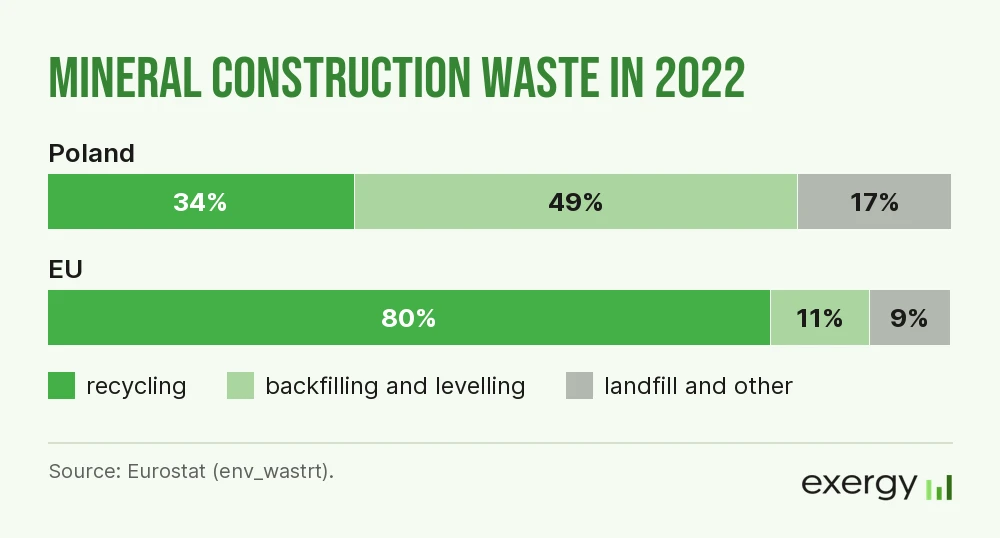
Poland is a good example of a weak cost signal for waste treatment. In 2026, the landfill fee is PLN 19.27 per tonne of concrete rubble and PLN 29.88 per tonne of gypsum waste. That is about €4.5 and €7. For mixed municipal waste, it is PLN 396.31, about €93 (converted at about PLN 4.25 per euro). The landfill's gate fee comes on top, but a difference of an order of magnitude remains. You can see the effect in the statistics. According to Eurostat, in 2022 only 34% of mineral construction waste in Poland was recycled, and 49% went to backfilling and levelling. The EU average is 80% recycling.
So it pays to count the product price more widely than the cost of raw material. Documented recycled content opens the way to Taxonomy-aligned investments, to tenders with environmental criteria and to building certifications. A lack of documented data works the other way: the product counts as fully virgin.
Does recycled content lower the quality of the finished product?
 A product with recycled content must meet exactly the same requirements as any other. Harmonised standards do not depend on the material, and the declaration of performance and CE marking have no softer version for secondary raw materials. The risk lies in the variable input, not in the percentage itself. Each material has its own limits:
- Concrete: EN 12620 describes the composition of recycled aggregate in categories (concrete, ceramics, bituminous materials, glass, impurities). National rules limit its share by exposure class; in Poland, the national supplement PN-B-06265 does this.
- Steel: you cannot remove copper from scrap out of liquid steel. Reinforcing bars tolerate more of it than sheet for pressing, so bars are made mainly from scrap.
- PVC: old profiles contain lead. Regulation (EU) 2023/923 allows up to 1.5% lead in recovered rigid PVC in selected building products until 2033, if they are labelled.
- Gypsum: recycled gypsum from boards carries paper, glass fibre and silicones. In the EU project Gypsum to Gypsum, only 56% of recycled gypsum samples met all quality criteria.
In practice, the quality of a product with recycled content depends on four things:
- input specification: composition, grain size, moisture and allowed impurities written into the supplier contract;
- delivery control: testing each batch before you accept it, not only the finished product;
- factory production control: more frequent tests when the share of recycled material or the supplier changes;
- industrial trials: raising the share step by step and checking the properties at each level.
Where does gypsum for plasterboard come from, and why does recycling matter more and more?
 Plasterboard is 90–95% gypsum core, and the rest is facing paper and additives. Gypsum for the core comes from three sources. Poland is a good example:
- Natural gypsum: in Poland, from the Nida Basin. The plants in Szarbków (Rigips) and Gacki (Siniat) use it.
- Synthetic FGD gypsum: a by-product of coal power plants. According to IGSMiE PAN, it is about 80% of Poland's supply of gypsum raw materials. Knauf (Bełchatów, Jaworzno) and Norgips (Opole) run plants next to power plants.
- Recycled gypsum: from production rejects and from construction and demolition waste. In the EU reference board from 2013, it made up 5% of the mass, and only 1% of it was post-consumer.
This structure will change, because FGD gypsum disappears together with coal power plants. In Germany, the industry expects the supply of FGD gypsum to fall from 5.1 million tonnes in 2022 to 2.9 million tonnes in 2030. By 2038, it should fall to zero. Natural or recycled gypsum will have to fill the gap. Yet little is recovered today: of about 1.9 million tonnes of used boards in the EU in 2013, 12.7% were recovered.
Chemistry favours recycling. Gypsum dihydrate burnt at about 150–160 °C loses part of its water and becomes a binder. Mixed with water, it returns to the dihydrate form. You can repeat this cycle many times, so gypsum from demolition can get a second and further life in a new board. The limit is not the gypsum itself, but what sticks to it: paper, glass fibre, silicones from moisture-resistant boards, fillers, metal and film. So the building site, not the factory, decides recycling. In Poland, gypsum must be sorted from other waste on site since 1 January 2025.
In Poland, few producers use waste from the market. Since 2014, Rigips has run the programme "Zbieraj i sortuj z Rigips" (collect and sort with Rigips). It takes back waste from building sites and processes it at its plant in Stawiany. Siniat says it returns waste from its own plants. We did not find public programmes for taking back site waste at other producers.
What does recycled content change in a plasterboard?
 The best documented test is the EU LIFE project Gypsum to Gypsum from 2013–2015. Five plants in Belgium, France, Germany and the United Kingdom raised the share of recycled gypsum and measured the effects. They made boards with 20–30% recycled gypsum, 25% on average. Two plants out of five reached the 30% target without lasting changes to the process. The results show the four themes of this article well:
- Rules: EN 520 requires properties from a board, not a particular origin of gypsum. For buildings that make a substantial contribution to the circular economy, the EU Taxonomy allows at most 65% of gypsum from virgin raw material. In Poland, a recycler who wants to sell gypsum as a product, not as waste, needs an individual decision in its permit. The Polish end-of-waste regulation covers FGD gypsum, but not board waste.
- Carbon footprint: at raw material level, recycled gypsum loses to quarried gypsum. A tonne of natural gypsum is 2.24 kg CO₂e (ÖKOBAUDAT). A tonne of recycled gypsum from boards, after collection, cleaning, drying and transport, is about 35–45 kg (Weimann et al., 2021). In the board, this still matters little, because raw gypsum gives about 9% of its footprint (Morsali et al., 2024). The rest comes mainly from gas in the dryer and in calcination. The change of gypsum into the hemihydrate form itself releases no CO₂. The gain shows elsewhere. According to an LCA for WRAP (2008), a tonne of gypsum waste in a mixed landfill causes about 122 kg CO₂e. The reason is methane from decaying paper. In recycling, it is 25–82 kg, depending on distance.
- Price: in the project, the cost of raw materials fell by 9.5%, but chemical additives rose by about 8% and electricity by 2.9%. In total, the variable cost per square metre of board fell by 0.6%, which is within the margin of uncertainty. The numbers improve where landfill is expensive. In Poland, the landfill fee for a tonne of gypsum waste is PLN 29.88, about €7.
- Quality: in studies linked to the project, only 56% of recycled gypsum samples met all quality criteria. Almost one in four exceeded the moisture limit. Boards with 17–28% recycled gypsum usually met the requirements of EN 520. But one trial stopped at a breaking load of 548 N against the required 550 N. Paper clumps in the calciner and raises water demand, and silicones from moisture-resistant boards cause blisters.
The Eurogypsum quality criteria from 2024 describe the requirements for recycled gypsum well:
- at least 80% gypsum dihydrate;
- moisture up to 10%;
- organic carbon, mainly paper, up to 2%;
- mineral fibres up to 0.1%;
- no visible impurities of glass, metal or plastic.
Recycled content in plasterboard mainly secures raw material for the time when FGD gypsum runs out. It also helps meet the criteria of the Taxonomy and building certifications. The market is already moving this way: in 2025, British Gypsum launched a board made from 100% recycled gypsum.
How do you document recycled content?
 A figure in a technical data sheet is only a claim. An investor, a building certification auditor or a customer's purchasing team will ask for proof. Proof can have four levels:
- Mass balance at the plant: waste transfer notes, certificates from suppliers of secondary raw material and a record of use. In Poland, transfer notes are in the BDO waste database. Without this, none of the next levels of proof can exist.
- Claim under ISO 14021: the share of recycled material by mass, split into pre- and post-consumer. The standard does not require external verification, but the claim must be verifiable.
- Third-party certificate: it depends on the raw material. For some materials, it confirms the percentage of recycled content in the product. For others, it confirms only the origin or quality of the raw material. The next section gives an overview of the systems.
- EPD: the SM indicator, checked by an independent verifier together with the whole life cycle calculation. In construction, this is the strongest proof, because it also shows the carbon footprint.
Three mistakes are the most common:
- A claim about the whole product when recycled content is only in one layer or in the packaging. The EmpCo Directive gives this case as an example of misleading practice.
- One figure from different streams: post-consumer recycled material, waste returned to the same process and by-products added up without a description.
- Mass balance carried into an EPD: ECO Platform rules do not allow mass balance in a declaration. You cannot assign recycled content to selected products this way. The actual input counts.
The EmpCo bans apply in EU countries from 27 September 2026, and in Poland from 27 September 2027. They concern communication to consumers, but business customers already expect the same level of proof. We explain where recycled content claims stand among other labels in our article on environmental labels and declarations of types I, II and III. The risk of slogans alone is covered in our guide on how to avoid greenwashing.
Which certificates confirm recycled content in each raw material?
 A certificate of recycled content does not exist for every raw material. Some systems confirm the percentage of recycled content in a product. Some certify only the plant and the origin of the raw material. Some concern the quality of recycled material, not its share. This is how it looks in building materials:
| Raw material | System | What it confirms | Can the result go into an EPD? |
|---|---|---|---|
| Plastics | ISCC PLUS, REDcert² | the plant; mechanical and chemical recycled material, under segregation, controlled blending or mass balance | only the physical share, without mass balance in the credit model |
| Plastics | RecyClass (EN 15343), GRS | the exact percentage of recycled content in the product | yes |
| PVC | VinylPlus Product Label, Recovinyl | a sustainability label with a range of recycled content; a register of the amount of PVC processed | plant data yes, the label alone no |
| Steel | ResponsibleSteel, producer labels (such as XCarb) | the plant and emission intensity; it does not certify the share of scrap | the EPD itself shows the share of scrap |
| Aluminium | ASI Chain of Custody; Hydro CIRCAL | ASI: origin under mass balance, without a percentage; CIRCAL: at least 75% post-consumer scrap, verified by DNV | ASI no, CIRCAL yes |
| Concrete | CSC, R module | the share of recycled aggregate in each delivery | yes |
| Aggregate, gypsum | CE and factory production control (EN 12620, EN 13242); in the EU also QUBA, BRL 2506, PAS 109 | quality and end-of-waste status, not the share of recycled content | the EPD itself shows the share |
| Wood | FSC Recycled, PEFC | the plant; the share of recycled raw material in the percentage or credit system | system |
The chain of custody model matters most when you choose a certificate. EPD programme operators allow only the physical share of recycled content in a declaration: segregation, controlled blending or the average share over a settlement period. Mass balance in the credit model and book and claim are excluded. This is set out in the ECO Platform rules, the ITB EPD verification checklist and by IBU. So a "circular" plastic with an ISCC PLUS certificate in the credit model is valid proof in the supply chain. But it will not raise the share of recycled content in an EPD.
For steel, aggregate and gypsum, no certificate of content exists. Here, the simplest credible path is an EPD with a statement of composition in line with ISO 14021. EPD International also requires you to state the share of post-consumer recycled content when it exceeds 5% of the product mass. If the percentage is to appear on a label or in a catalogue, add verification of the claim under ISO 14021.
Do you want to show recycled content in figures that hold up with customers?
We prepare EPDs for building products, in which recycled content and its effect on the carbon footprint are calculated under EN 15804. We also carry out circular economy analyses. They show how much secondary raw material a product can take and what this changes in the results.
Is the percentage of recycled content to go into a catalogue, onto a label or into a tender offer? We check it in a verification of environmental claims under ISO 14021. We help investors who want to recover materials from a building before demolition with a pre-demolition audit.