
Urban wastewater treatment uses about 0.8% of all energy in the EU. This energy costs operators around €2 billion a year, between 25% and 56% of their operating costs (European Commission impact assessment, 2022). Yet the Commission found that the sector makes little use of energy efficiency and renewable energy. The recast Urban Wastewater Treatment Directive now requires regular energy audits. The largest plants must complete the first one by 31 December 2028.
- Wastewater treatment plant energy audit: every four years, including the sewer network; first by the end of 2028 for plants of 100,000 p.e. or more.
- Plants of 10,000 to 100,000 p.e.: first audit by the end of 2032.
- Audit scope: energy savings and the potential of biogas, waste heat and other renewable energy.
- Energy neutrality: renewable energy from plants of 10,000 p.e. or more must cover 20% of their energy use by 2030 and 100% by 2045.
- National law: EU countries must transpose the directive by 31 July 2027.
What does the Urban Wastewater Treatment Directive say about energy audits?
 The recast Urban Wastewater Treatment Directive is Directive (EU) 2024/3019 of 27 November 2024. It replaces the directive from 1991 and has been in force since 1 January 2025. Besides rules on the quality of treated wastewater, it adds duties on energy. Article 11, "Energy neutrality", sets them out.
Under Article 11, EU countries must make sure that wastewater treatment plants and collecting systems have an energy audit every four years. A collecting system is the network of pipes and sewers that carries wastewater to the plant. So the audit covers the plant and also the sewer network that serves it.
The directive does not define the audit itself. It uses the definition from the Energy Efficiency Directive (EU) 2023/1791. There, an energy audit is a systematic procedure. It shows how a site uses energy and finds cost-effective savings. It also shows the potential to use and produce renewable energy.
EU countries must transpose the directive into national law by 31 July 2027. National law will decide who orders the audit, who checks it and what the penalties are. Poland has asked the Court of Justice of the EU to cancel some rules of the directive. The case is about extended producer responsibility for removing micropollutants. It does not cover energy audits or energy neutrality.
Which plants need an energy audit, and by when?
 The deadline for the first energy audit depends on the size of the plant. Size is measured in population equivalent (p.e.). One p.e. is the organic load that one person produces in a day, equal to 60 g of oxygen demand (BOD5). A plant of 100,000 p.e. treats the same load as a town of 100,000 people. This is true even if part of the wastewater comes from industry.
| Plant size | First energy audit | Next audits |
|---|---|---|
| 100,000 p.e. or more | by 31 December 2028 | every four years |
| 10,000 to 99,999 p.e. | by 31 December 2032 | every four years |
In the EU, 7,527 plants have a load above 10,000 p.e. They treat 81.4% of the total load and use a similar share of the energy (European Commission impact assessment, 2022).
For plants below 10,000 p.e., Article 11 sets no deadline for a first audit. The Commission found that audits for these many small plants would be out of proportion to their load and energy use. These plants are also outside the energy neutrality target, and they do not need to publish energy data.
What does a wastewater treatment plant energy audit cover?
 The directive says what the audit must look for. The auditor must find cost-effective ways to use less energy. The auditor must also find ways to use and produce more renewable energy. The directive puts special focus on biogas and on waste heat recovery, on site or through a local energy system. Each of these steps should also reduce greenhouse gas emissions.
At a plant, this means a review of several areas:
- Aeration: blowers, diffusers in the biological tanks and oxygen control; in activated sludge plants, this is usually the largest user of electricity.
- Pumping stations: pumps at the plant and in the sewer network, their efficiency and their control.
- Sludge treatment: thickening, dewatering and drying of sludge.
- Biogas: output of the digesters, combined heat and power (CHP), the gas flare and co-digestion of other waste.
- Heat: heating of digesters and buildings, and heat from treated wastewater for heat pumps.
- Solar and other sources: roofs, free land and tanks where you can install solar panels.
Annex VI of the Energy Efficiency Directive gives minimum criteria for audits. An audit uses current, measured data on energy use, and load profiles for electricity. Where possible, it assesses measures by life cycle cost, not by simple payback time. These criteria apply directly to company audits. The wastewater directive only refers to the definition of an audit, so for plants the criteria are good practice. The EN 16247 standards and ISO 50002 also describe how to carry out an energy audit.
Energy neutrality: targets for 2030 to 2045
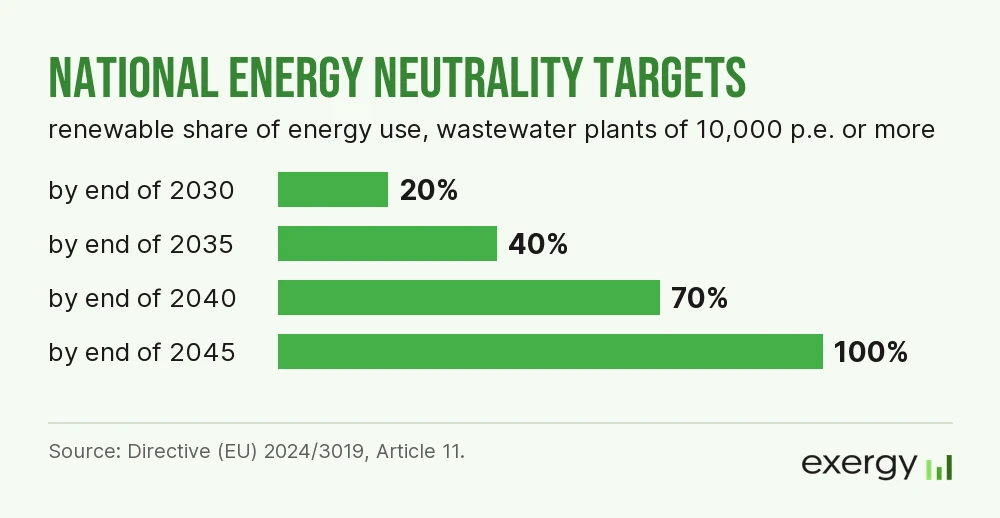
 The audit is the first step towards a goal that the directive calls energy neutrality. The owners or operators of plants of 10,000 p.e. or more produce renewable energy. This energy must cover a growing share of the energy that these plants use. Each EU country must reach the targets at national level:
- 20% by 31 December 2030;
- 40% by 31 December 2035;
- 70% by 31 December 2040;
- 100% by 31 December 2045.
The Commission estimates that sludge digestion could produce around 16,000 GWh of biogas a year in the EU (impact assessment, 2022).
The target applies to the country, not to each plant. A large plant with sludge digestion may produce more energy than it uses. A small plant without digesters produces much less. Energy from biogas, the sun, water, wind and heat counts, on the plant site or elsewhere. It also counts if the operator uses it outside the plant.
Renewable energy that the operator buys does not count, even with guarantees of origin. The directive allows two exceptions. A country may fail to reach a target despite all measures, especially those found in the audits. It may then allow plants to buy energy from non-fossil sources:
- 2040 target: up to 5 percentage points of the 70%, only for a country that shows it will need the full 35% in 2045.
- 2045 target: up to 35% of the energy.
The directive also says that steps towards energy neutrality should not increase emissions of methane or nitrous oxide. If a plant expands sludge digestion, the audit should also check that the biogas system does not leak.
What energy data will plants report?
 The directive requires monitoring of the energy that plants of 10,000 p.e. or more use and produce. It also requires monitoring of greenhouse gas emissions: at least carbon dioxide, methane and nitrous oxide. By 31 December 2030, each EU country will create a data set with this information for each such plant. It will update the data set every year.
Some of the data will also be public. For each plant of 10,000 p.e. or more, people will find online:
- the energy used to treat wastewater, in kWh, in total and per cubic metre;
- the renewable energy produced each year, in GWh, by source;
- the direct greenhouse gas emissions each year, in tonnes of CO₂ equivalent.
The value in kWh per cubic metre will let people compare plants of similar size. An energy audit calculates it anyway. A corporate carbon footprint helps you organise the emissions data.
How does it relate to the company energy audit under the EED?
 The Energy Efficiency Directive (EED) already requires energy audits from companies. The duty depends on energy use, not on company size:
- Above 10 TJ (2.78 GWh) a year: an energy audit every four years, the first by 11 October 2026.
- Above 85 TJ (23.61 GWh) a year: a certified energy management system by 11 October 2027, instead of the audit.
Many water companies are below these thresholds. The Commission calculated that an average plant of 100,000 p.e. uses about 7.2 TJ, or 2 GWh, of energy a year (impact assessment, 2022). This is below the 10 TJ threshold. A water company with one such plant and little energy use for drinking water may have no company audit duty. The plant audit under the wastewater directive applies to it anyway.
Both audits use the same definition from the EED, so their scope is largely the same. The plant audit is narrower in place and wider in content. It covers one plant with its sewer network, and it must assess the potential of biogas and waste heat. National law will decide if one audit can meet both duties. Until then, plan the company audit so that it also meets the wastewater directive.
The wastewater directive does not say who may carry out the plant audit. For company audits, the EED requires independent experts who are qualified or accredited. National law will set the rules for plant auditors.
How to prepare a plant for its first energy audit?
 Operators of plants of 100,000 p.e. or more have just over two years until the first audit. The quality of the audit depends on data, and measured data takes months to collect. You can do five things now:
- Metering: sub-meters on blowers, pumping stations and sludge treatment; without them, the auditor has to estimate.
- Three years of data: use of electricity, heat and gas, biogas and CHP output, wastewater volume in m³ and load in p.e.
- List of pumping stations in the sewer network: power, running hours and energy use, because the audit also covers the collecting system.
- Review of renewable energy options: roofs and land for solar panels, sludge for digestion, heat from treated wastewater.
- Estimate of methane and nitrous oxide emissions: a baseline for the national data set from 2030 and for checking process changes.