A CBAM certificate for imports in the third quarter of 2026 costs EUR 82.32 per tonne of emissions (European Commission, 2026). So every tonne of emissions embedded in imported steel, aluminium or cement now has a price. But the CBAM calculation is hard, because the data you need comes from plants outside the EU. A producer in China or Turkey does not have to share it, and without it you must use default values with a mark-up. At the end, free allocation for EU producers and any carbon price paid in the country of origin also lower the number of certificates. You will learn:
- how to do the CBAM calculation: embedded emissions per tonne, minus free allocation and emissions already paid for, times the mass of goods;
- where emissions data comes from: from the operator of the plant that makes the goods, on the European Commission template;
- when to use default values: when your supplier sends no data; in 2026 they carry a 10% mark-up, or 1% for fertilisers;
- when to buy certificates: from 1 February 2027; from 2027 you must cover half of the year's import emissions at each quarter end;
- when the CBAM declaration is due: for 2026 imports, by 30 September 2027.
Who must file a CBAM declaration?
 CBAM, the EU Carbon Border Adjustment Mechanism, puts a carbon price on some goods imported into the EU. It reduces the risk of carbon leakage, that is, production moving to countries without a carbon price. Through it, the importer pays for the greenhouse gas emissions released when the goods were made outside the EU. You file a declaration when you import over 50 tonnes of cement, fertilisers, iron and steel, or aluminium in a calendar year. Hydrogen and electricity are covered whatever the amount. We list the goods subject to CBAM and their CN codes, which you find in your customs declaration, in our article on CBAM CN codes.
The threshold works on an all-or-nothing basis. Once you pass it, your CBAM obligations cover all your imports of that year, not only the part above 50 tonnes. A company not established in the EU acts through an indirect customs representative, and then the representative must have authorised CBAM declarant status.
If your company imported these goods before, it knows CBAM from the transitional period. Until the end of 2025, importers sent quarterly CBAM reports in the CBAM Transitional Registry and paid nothing. National authorities check these reports and can still ask for corrections. From 2026, you file an annual CBAM declaration instead, and you pay for emissions with CBAM certificates.
To calculate CBAM and report it, you go through six steps. I describe them one by one below:
- Authorised CBAM declarant status: an application in the CBAM Registry.
- Supplier data: emissions from the plant where the goods were made.
- Embedded emissions: a calculation per tonne of goods, or default values.
- Verification: an accredited verifier checks actual emissions.
- Certificates: work out the number, buy them and surrender them.
- CBAM declaration: file it in the CBAM Registry by 30 September of the next year.
One example runs through the whole article: 100 tonnes of hot-rolled flat products (7208) imported from a steel plant in China in 2026.
How do you get authorised CBAM declarant status?
 The first step is authorised CBAM declarant status, because without it you cannot release goods above the 50-tonne threshold for free circulation. You apply in the CBAM Registry, and the competent authority of the EU member state where your company is established decides. In your application, you give, for example:
- your EORI number and company details;
- a tax certificate showing no outstanding recovery orders for national tax debts;
- a statement that there were no serious breaches of customs or tax rules in the last five years;
- an estimate of your imports by type of goods for this year and the next.
The authority has 120 days to decide, or up to 180 days if it asks for more information. So it pays to apply early, before your imports get close to the threshold.
Younger companies need one more thing. If your company was not established for the two full financial years before the application, the authority will ask for a guarantee. It covers the value of the certificates for your planned imports.
The date of your application also matters. A company that applied by 31 March 2026 may keep importing until the decision. If you apply later, you cannot import goods above the threshold before you get the status. If the authority refuses, it uses default values to set the embedded emissions of your imports since 1 January 2026. A penalty is based on them.
The status alone does not let you calculate emissions, though. For that, you need data from the plant where the goods were made.
How do you collect emissions data from a supplier outside the EU?
 The operator of the plant that made the goods prepares the emissions data, not the importer. In our example, that is the steel plant in China. From 2026, the operator sends the data in an operator's emissions report, in English. The template in Annex IV to Regulation 2025/2547 sets what the report must contain. The Commission offers an Excel file for this. It is recommended but not required. The old file from the transitional period does not fit.
How you get the data depends on whether the plant is registered in the CBAM Registry. If it is, the operator shares a summary of the data and the verification report with you there, without full production data. If it is not, the operator sends you the full report, and you upload it to the registry with your declaration.
Either way, you need from your supplier:
- the direct emissions of the production process and the amount of goods produced in the reporting period;
- emissions from the electricity used, if the goods also have indirect emissions (cement, fertilisers and agglomerated iron ore);
- the embedded emissions of precursors, such as pig iron or clinker, with data from their producers;
- a verification report from an accredited verifier;
- data on any carbon price paid in the country of origin, if you want to deduct it.
If you buy the same goods from several plants, you collect data from each one. For 2026 imports, the reporting period is the whole of 2026, and the European Commission expects the first verification reports in early 2027. So start talking to the suppliers in your supply chain early, because the plant operator orders the verification, not you.
From this data, the steel plant calculates the emissions embedded in each tonne of steel.
How do you calculate embedded emissions?
 You calculate embedded emissions per tonne of goods, for each CN code and plant. The result is specific embedded emissions in tonnes of CO₂ equivalent per tonne of goods (t CO₂e/t). The method depends on what the goods are made from, so the rules have two types of goods:
- simple goods, made only from materials and fuels with zero embedded emissions: divide the attributed emissions by the amount of goods produced;
- complex goods: add the embedded emissions of the precursors to the process emissions, and then divide by the amount of goods. For each precursor, this is its mass times its emissions per tonne.
Attributed emissions are the direct emissions of the process. For cement, fertilisers and agglomerated iron ore, they also include indirect emissions. Direct emissions include heat used in the process, even if the plant buys it. You usually calculate indirect emissions with the grid emission factor of the country of origin. You can use the factor of one power plant only if you have a direct line or a direct contract with it (PPA).
Sometimes a plant has its own data but gets no data from the producer of a precursor. It does not have to give up its actual data. It can use a default value for that precursor and its own data for the rest.
It is worse when your supplier sends no data at all. Then you must use default values.
When do you use CBAM default values?
 The European Commission publishes default values for each country and product (Implementing Regulation (EU) 2025/2621). You use them when your supplier sends no emissions data or when the data cannot be verified. They are the average emissions per tonne in the exporting country, plus a mark-up. So if your supplier emits less than the average, you pay for emissions that did not happen. The mark-up grows each year:
- 2026: 10%;
- 2027: 20%;
- from 2028: 30%;
- fertilisers: 1% from 2026.
The mark-up is added to the total emissions in the default value table, but you do not have to work it out yourself. The CBAM Registry does it for you. Default values also do not need verification. For the steel in our example, the default value for China is 3.187 t CO₂e per tonne before the mark-up. For the same goods from Turkey, it is 2.428 t CO₂e. The Commission must review default values by 2027 at the latest.
With actual data, the table is not enough, because a verifier must check the plant's figures.
Who verifies embedded emissions?
 You need verification when you declare actual emissions. With default values, there is none. The plant operator orders the verification, not the importer. The verifier must be accredited by a national accreditation body in an EU country under EN ISO/IEC 17029. Accredited verifiers register in the CBAM Registry from 1 September 2026.
The verifier checks:
- embedded emissions per tonne of goods, with a materiality level of 5%;
- the free allocation linked to the goods, also with a 5% level;
- data on production, precursors and how emissions are attributed to goods.
In the first year, the verifier normally visits the plant. A virtual visit is allowed only if a physical visit took place in the previous reporting period.
The steel plant orders the verification, but you, as the authorised declarant, are responsible for the whole declaration, including the verification report. Also watch out for verification offers sent straight to importers. The Commission warns that they are likely a scam, because the operator orders the verification.
Once the emissions are known and checked, you can work out how many certificates you need.
How do you calculate CBAM certificates and the CBAM cost?
 One CBAM certificate equals one tonne of emissions, but you do not buy them for all embedded emissions. The European Commission's formula works like this. From embedded emissions per tonne, you take away free allocation per tonne and emissions already paid for in the country of origin. Then you multiply the result by the mass of goods. Each part has its own rules:
- embedded emissions per tonne: actual, or default with the mark-up;
- free allocation per tonne: with default values, the CBAM factor times a correction factor times the CBAM benchmark for the goods. With actual data, you use the process benchmark and add the precursors;
- carbon price already paid in the country of origin: with actual data, you deduct the price actually paid and certified by an independent person. With default values, only a default price, which the Commission may set from 2027.
Free allocation is deducted because EU producers still get part of their allowances in the EU Emissions Trading System (EU ETS) for free. But this relief will shrink. The correction factor is 100% in 2026–2030, and the CBAM factor falls each year and stops applying from 2034.
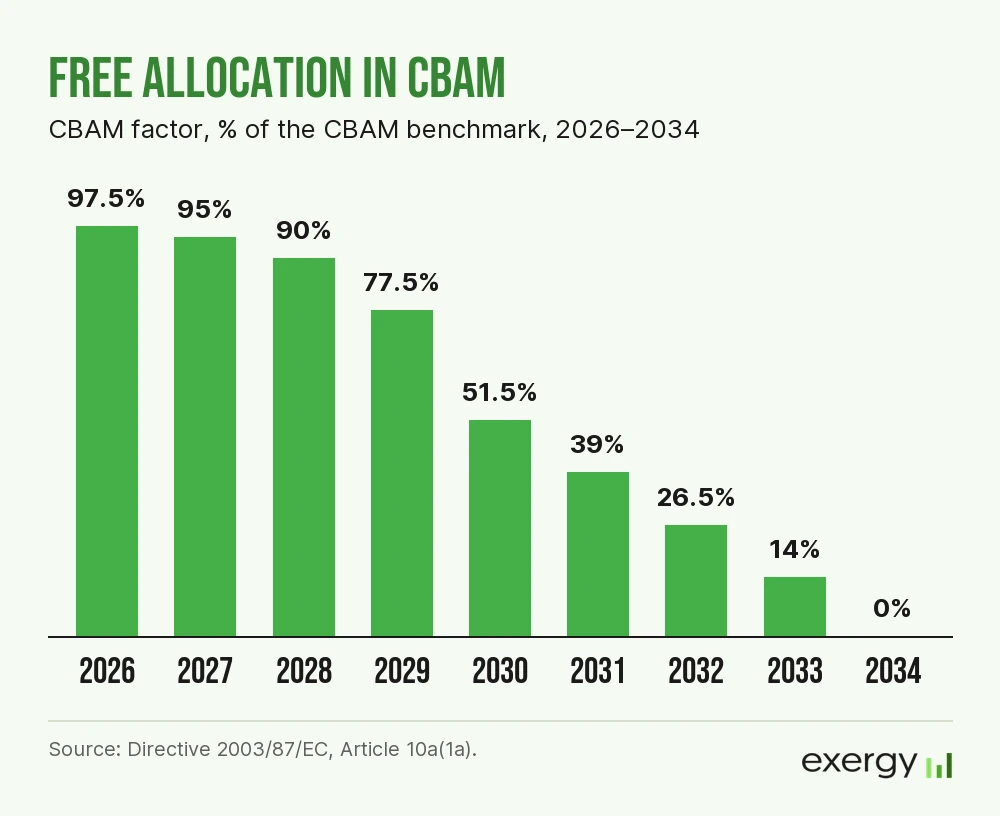
The Commission proposes a slower fall of the factor from 2028 (proposal COM(2026) 616), but the values for 2026 and 2027 stay the same. If the result for a product is negative, you use zero. You cannot deduct it from other products.
Here is the CBAM cost for the steel in our example. The 100 tonnes from China arrive in the second quarter of 2026. The calculation uses default values and a CBAM benchmark of 1.370 t CO₂e/t.
| Step | Calculation | Result |
|---|---|---|
| default value with a 10% mark-up | 3.187 × 1.10 | 3.5057 t CO₂e/t |
| embedded emissions | 100 t × 3.5057 t CO₂e/t | 350.57 t CO₂e |
| free allocation per tonne | 0.975 × 1.00 × 1.370 t CO₂e/t | 1.33575 t CO₂e/t |
| free allocation | 100 t × 1.33575 t CO₂e/t | 133.575 t CO₂e |
| certificates | 350.57 − 133.575 = 216.995 | 217 |
| CBAM cost at the second-quarter 2026 price | 217 × EUR 75.28 | EUR 16,335.76 |
If the same steel came from Turkey, you would need 134 certificates, or EUR 10,087.52. A platform fee will be added to the cost, but its amount is not yet set. Rounding to a whole certificate comes from the Commission's draft regulation on CBAM declarations of November 2026.
We calculate embedded emissions from your suppliers' data and compare the certificate cost for each of them. We also estimate the cost for the next years, as free allocation shrinks.
CBAM reporting →You still have to buy these certificates, and the deadlines differ for 2026 imports and later years.
How do you buy and surrender CBAM certificates?
 From 1 February 2027, you buy certificates on the common central platform, which the European Commission runs. The member state where you are established sells them to you. You start buying in the CBAM Registry and pay on the platform. Then the certificates go to your account in the registry. After that, you cannot sell them or transfer them to another company, even within a group.
The price of CBAM certificates depends on when the goods arrived:
- 2026 imports: the average EU ETS auction price for the quarter of import. It was EUR 75.36 for the first quarter, EUR 75.28 for the second and EUR 82.32 for the third (European Commission, 2026). The fourth-quarter price comes on 4 January 2027;
- imports from 2027: the average auction price of each calendar week.
For 2026 imports, there is no quarterly requirement. So you buy all certificates, 217 in our example, between 1 February and 30 September 2027. From 2027, the rules get stricter. You must hold enough certificates at the end of each quarter. They must cover at least 50% of the embedded emissions of goods imported since January. You can base this on default values without the mark-up, minus free allocation. Or you can base it on the number of certificates you surrendered for the previous year. You can use this second option only if you import the same goods, by CN code and country of origin, as in your previous declaration.
You surrender the certificates in the CBAM Registry by 30 September. If you buy too many, you can sell the surplus back at the price you paid, within the limit in Article 23 of the Regulation. You apply for this buy-back by 31 October. But be careful with certificates for 2026. They can only be bought back in 2027. Those left on your account are cancelled on 1 November 2027 without compensation.
How do you file the CBAM declaration, and when?
 You file the CBAM declaration in the CBAM Registry by 30 September for the previous year. The first is due by 30 September 2027 for 2026 imports. This is the same deadline as for surrendering certificates, so in practice you prepare both together. The Commission will open the registry module for declarations in 2027.
A CBAM declaration has four parts:
- Quantity of goods: tonnes of each type of goods, or megawatt hours for electricity, including imports below the threshold.
- Embedded emissions: the total for these goods, verified if they are actual emissions.
- Number of certificates: after the free allocation adjustment and the carbon price paid in the country of origin.
- Verification reports: copies, if you declare actual emissions.
Filing the declaration does not close the matter. The European Commission or a national authority may review it until the end of the fourth year after the year it was due. You keep your records, including verification reports, for the same period. For the 2026 declaration, this means until the end of 2031.
A draft Commission regulation on declarations (November 2026) lets you correct your declaration until 30 September. This works only if you have not yet surrendered the certificates. If you prefer to leave the calculation and the declaration to experts, see our CBAM reporting page.