

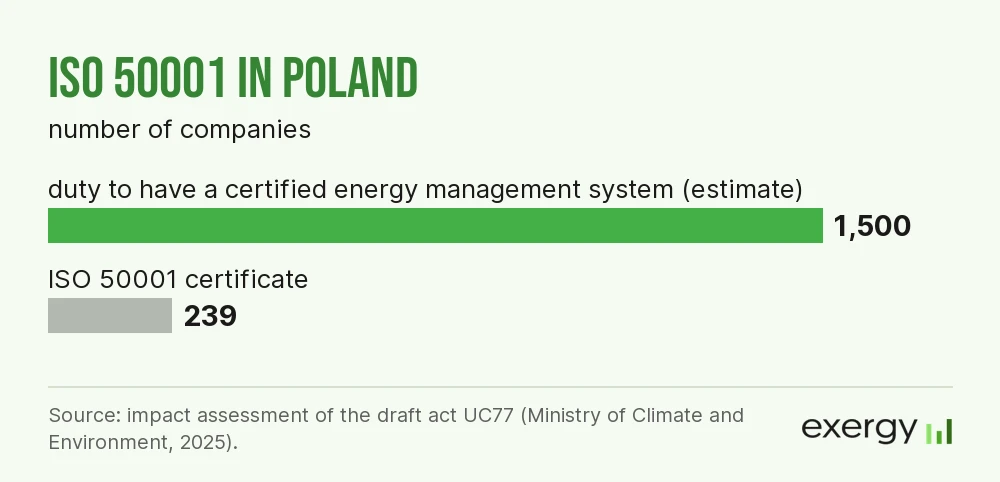
Poland's Ministry of Climate and Environment expects about 1,500 companies to need a certified energy management system. Only 239 hold an ISO 50001 certificate (impact assessment of the draft act, 2025). The EU deadline is 11 October 2027. But the Polish act that will apply it is still a draft. The ministry says companies will get two years from the date the act comes into force.
- Use below the threshold: you avoid ISO 50001 if your average yearly energy use over three years is 85 TJ or less.
- ISO 14001 or EMAS: a certified environmental system that includes an energy audit gives an exemption above the threshold.
- Energy performance contract: a deal with an ESCO that puts in an energy management system also gives an exemption.
- Audit instead of a system: at 10 to 85 TJ, you need an energy audit every four years and a public action plan.
- Deadline and penalty: two years from the act's entry into force; without a system, a fine of up to 5% of revenue.
Who must implement ISO 50001 in Poland, and from when?
 Poland's current Energy Efficiency Act does not require ISO 50001. Its Article 36 requires large companies to have an energy audit every four years. A company with an energy management system is exempt from this audit.
The duty comes from the EU Energy Efficiency Directive (EED), Directive (EU) 2023/1791. Its Article 11(1) covers companies that use over 85 TJ a year, as an average of the last three years. By 11 October 2027, they must have an energy management system certified by an independent body. In Poland, an amendment to the Energy Efficiency Act will apply this rule. The draft act, UC77, sets out:
- threshold: 23,611 MWh of final energy a year, as a three-year average, with all energy carriers added together;
- standard: a system in line with ISO 50001, certified by an independent, accredited body;
- deadline: two years from the act's entry into force;
- notice: within 30 days of implementation, to the President of the Energy Regulatory Office (URE);
- penalty: up to 5% of the previous year's revenue, set by the President of URE.
The duty will cover about 1,500 companies, and 239 hold an ISO 50001 certificate. The ministry assumes that some of the others already run an energy management system and only need certification.
How do you check whether your company exceeds 85 TJ?
 The threshold is based on the average yearly use of final energy over the last three years. 85 TJ equals 23,611 MWh. The total includes all energy carriers:
- fuels: natural gas, heating oil and coal, and also fuel for vehicles and LPG for forklifts;
- electricity: from the grid and from your own sources, including solar power you use on site;
- heat and cooling: from a district heating network or another supplier.
Add up all plants and branches. The threshold applies to the company, not to a single site.
The result is most often too low when you leave out fuel in vehicles and forklifts. It is safer to include energy that you resell to tenants.
The three-year average changes slowly. If your use falls by 9 TJ in one year, the average falls by 3 TJ. So getting below the threshold through savings takes several years.
Does ISO 14001 or EMAS exempt you from ISO 50001?
 Yes, if the environmental management system includes an energy audit of the company. Article 11(11) of the EED sets out this exemption, and the draft Polish act repeats it. On the same basis, the draft act exempts such companies from the separate audit required above 10 TJ.
An ISO 14001 certificate alone is not enough. The energy audit within the system must meet the minimum criteria in Annex VI of the directive:
- data: current and measured, and for electricity also load profiles;
- scope: a detailed review of energy use in buildings, installations and transport;
- measures: specific steps to use energy better, and a check of the potential for solar, wind or other green energy;
- costs: where possible, a life cycle cost analysis instead of a simple payback period.
An independent, accredited body must also certify the environmental system.
A company that already has ISO 14001 does not build a second system with its own certification. It adds an energy audit under ISO 50002. Then it puts the results into the targets and procedures of the system.
When does an energy performance contract replace the system?
 The third path is an energy performance contract, usually with an energy service company (ESCO). The contractor carries out the upgrade. Its pay depends on the energy savings that the contract guarantees. Article 11(10) of the EED and the draft Polish act give an exemption from the system and the audit. The contract must:
- cover the company: you carry it out at the company's sites;
- put in an energy management system: in line with ISO 50001;
- meet Annex XV of the directive: it must set the guaranteed savings, the term, the split of savings and how you check them.
This path makes sense when the company plans a large investment anyway. Examples are a new heat source, a compressor room or lighting. You then pay for it from the savings. It does not work as a mere way around ISO 50001. The contract binds the company for the whole period in which you settle the savings.
What remains if you do not implement ISO 50001?
 Below 85 TJ, duties remain if you use more than 10 TJ (2.78 GWh) a year. The EED set the first audit for 11 October 2026. The draft Polish act gives 12 months from its entry into force. An energy efficiency auditor with a certificate from an accredited body carries out the audit. After the audit, you must also:
- prepare an action plan: within 90 days, with a schedule and a way to track progress;
- publish the plan: in the annual report and on your website, by 31 March of the next year;
- notify the President of URE: about the audit and the action plan.
Each year, the President of URE draws 5 to 10% of audits for checks.
| Average yearly energy use over three years | Duty | Deadline |
|---|---|---|
| up to 10 TJ (2.78 GWh) | no duty to have an audit or a system | none |
| 10 to 85 TJ | energy audit every four years and an action plan. Instead of the audit: ISO 50001, ISO 14001 or EMAS with an audit, or an ESCO contract | first audit: 12 months from the act's entry into force |
| over 85 TJ | a certified energy management system, or ISO 14001 or EMAS with an audit, or an ESCO contract | two years from the act's entry into force |
Do you want to check which path fits your company?
We can calculate your energy use for three years. Then we check if you exceed 10 or 85 TJ. We carry out energy audits of companies in Poland, also within ISO 14001. If an energy management system is the best option, we set up ISO 50001 and prepare you for certification. See also an energy audit we carried out for a new laboratory building.